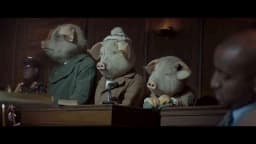
ADLANTIS launched Time for Good Ideas in Germany in February 2022, a self-promotion film positioning the Munich agency across strategy, design, and film

ADLANTIS Finds the Idea in the Ordinary with Time for Good Ideas
Time for Good Ideas is a 2022 agency self-promotion film produced and published by ADLANTIS, a Munich-based creative consultancy, to position its integrated offer of strategy, design, and film services to prospective clients in Germany.
ADLANTIS published the campaign in February 2022 as a single film asset, submitted by Sebastian Friedrich-Leser of adlantis Marketing + Consulting GmbH. The creative premise is disarmingly direct: meaningful ideas are not reserved for boardrooms or briefing documents. As the agency states, "even in the most ordinary situations like in a supermarket creativity can unfold — there is always time for good ideas". That observation becomes both the campaign's thesis and its structural engine, with montage used to move the viewer through familiar, mundane environments where the spark of a genuinely useful thought can surface without warning.
The campaign operates across the three pillars ADLANTIS presents as its core disciplines. Strategy, design, and film are not listed as separate service lines so much as a continuous creative loop — each one feeding the others in pursuit of what the agency describes, in the original German, as "DIE IDEE IST DER SCHATZ, DEN ES ZU FINDEN GILT", translated as the idea is the treasure that must be found. That treasure-hunt metaphor gives the film its emotional register: not a credentials reel, but an invitation. The agency positions itself as a guide willing to dive into oceans of creativity alongside a client and surface something genuinely differentiated.
In Germany, where the advertising-agency landscape spans global network holding companies and a dense tier of independent specialists, a self-promotion film of this kind functions as a positioning statement as much as a demonstration of craft. Clapboard scores the campaign 58 out of 100, reflecting its clear strategic intent and coherent creative concept against the competitive noise of agency self-promotion in the German market.
ADLANTIS positioned this 2022 self-promotion film against a specific tension in the German creative services market. Independent agencies in Germany compete with well-resourced global networks for mid-market clients who often equate scale with strategic credibility. According to data tracked by COMvergence and reported by Ad Age, GroupM held approximately $63.9 billion in global billings in 2022, representing a commanding share of the global market, which illustrates the structural asymmetry that smaller independents like ADLANTIS must navigate. In Germany specifically, that asymmetry is felt acutely, as network-affiliated agencies dominate retainer relationships with large domestic and multinational advertisers.
The strategic answer ADLANTIS provides is not to compete on scale but on creative proximity. The campaign's central argument — that an idea can emerge in a supermarket aisle as readily as in a strategy workshop — implicitly contrasts the agency's nimble, founder-level attention against the process-heavy structures of larger competitors. This positions ADLANTIS in the same conceptual territory occupied by other European independent creative consultancies that have made intimacy and interdisciplinary thinking their primary differentiators, though ADLANTIS does so through film rather than through written manifestos or editorial thought leadership.
The global media and entertainment agency segment was forecast to grow at a compound annual rate of 12.3 percent from 2021 through 2026, according to Business Wire, suggesting that the category ADLANTIS operates within was expanding rapidly in the period the campaign was released. For a German independent agency founded, according to LinkedIn, in 2017 and describing itself as focused on creative, digital, and long-term solutions, entering that growth window with a clear creative identity was a defensible and timely strategic move. The film medium itself signals confidence: committing to a produced, edited film for self-promotion demonstrates exactly the craft the agency is selling to prospective clients across Germany.
Montage is the governing creative device in the Time for Good Ideas film. ADLANTIS deploys it not as a stylistic flourish but as a structural argument: by cutting between ordinary environments and moments of apparent creative realisation, the film makes the editing rhythm itself embody the campaign's thesis. The pace of assembly communicates that ideas arrive in fragments, that creativity is associative rather than linear, and that the agency's eye is always active regardless of context.
The supermarket setting, cited explicitly in the campaign description, is the film's most deliberate image. It is a location that carries no cultural prestige — no beachside epiphany, no minimalist studio — and that ordinariness is precisely the point. By choosing an environment that any client, any viewer, inhabits routinely, ADLANTIS makes its creative promise feel accessible rather than rarefied. The idea is not something the agency conjures in isolation; it is something that emerges in the shared, unremarkable texture of daily life, which is where most business problems also originate.
The campaign's tagline — "We take every chance for a good idea" — appears as both a caption and a behavioural commitment. In execution, this translates to a film that reads as documentation rather than performance: the agency is not staging creativity but observing it. That distinction, when communicated through film, requires precise editorial control, specifically the ability to construct a credible sense of spontaneity through deliberate montage sequencing.
Production credits for the Time for Good Ideas campaign are not publicly documented beyond the submission by Sebastian Friedrich-Leser of adlantis Marketing + Consulting GmbH. The film was distributed as a single media asset on YouTube and reached 12,778 views and 14 likes, as reported by Clapboard. The absence of a named director or production company in available records is consistent with a founder-led, in-house production model common among boutique German creative agencies positioning their own capabilities.
Verified performance data for the Time for Good Ideas campaign is limited to archive metrics reported by Clapboard. The film recorded 12,778 views, 14 likes, and one comment as catalogued in the Clapboard archive, with the submission published in April 2022 following the campaign's February 2022 release in Germany. No coverage of the campaign has been identified in trade publications including Campaign, Ad Age, Adweek, The Drum, or Contagious, as confirmed by Clapboard's editorial research.
Those numbers are modest against the scale typical of widely distributed brand campaigns, but the frame of reference for an agency self-promotion film in Germany is different. The audience for this work is not mass consumers but a narrow segment of marketing decision-makers, procurement leads, and brand managers considering agency partnerships. In that context, the relevant metric is not view volume but the quality of attention the film commands among the right viewers — a dimension that archive data cannot fully capture.
Structurally, the campaign demonstrates several qualities that experienced observers of agency self-promotion associate with effectiveness. The creative concept is specific rather than generic. The film medium matches the service being sold. The strategic rationale is embedded in the execution rather than stated separately. And the tone — exploratory and confident rather than boastful — is calibrated to the kind of clients an independent German agency with integrated strategy, design, and film capabilities is most likely to attract. Clapboard scores Time for Good Ideas 58 out of 100, acknowledging the coherence of its creative logic while noting that limited distribution and the absence of measurable client-facing outcomes constrain the campaign's demonstrable impact.
Time for Good Ideas is a 2022 agency self-promotion film produced by ADLANTIS in Germany. Published in February 2022, it positions the Munich-based agency across strategy, design, and film services, using montage to argue that creative ideas can emerge in any ordinary environment, including a supermarket, as reported by Clapboard.
ADLANTIS created the campaign entirely for itself as a self-promotion exercise. The submission was made by Sebastian Friedrich-Leser of adlantis Marketing + Consulting GmbH, as documented by Clapboard. No separate director or external production company is credited in publicly available records for this 2022 German campaign.
The film uses montage as its primary creative device. ADLANTIS assembles cuts across ordinary environments to make the editing rhythm itself express the campaign's argument that good ideas surface anywhere, as documented by Clapboard. The supermarket setting is the film's most deliberate image, chosen precisely because it carries no cultural prestige.
The campaign recorded 12,778 views, 14 likes, and one comment in the Clapboard archive. No coverage appeared in major trade publications. Clapboard scores the campaign 58 out of 100, reflecting a coherent creative concept and clear strategic intent set against limited measurable distribution for this 2022 German agency self-promotion film.
The tagline — "We take every chance for a good idea" — functions as a behavioural commitment, not merely a slogan. ADLANTIS uses it to signal that the agency's creative attention is always active, positioning the Munich firm as a continuously engaged partner across strategy, design, and film for clients in Germany, as documented by Clapboard.
ADLANTIS selected film as the medium for self-promotion because the format directly demonstrates the craft the agency sells. Producing a finished film for internal promotion signals capability to prospective clients evaluating agency partners in Germany, where independent agencies compete with large network-affiliated competitors, as contextualised by Clapboard and LinkedIn agency profile data.
.webp)
Creative Collaboration Platform: The Backbone of Modern Creative WorkWhat is a creative collaboration platform?Clapboard defines a creative collaboration platform as the operational core for today’s distributed creative teams. This is not a collection of digital collaboration tools stitched together; Clapboard’s system


Understanding the Creative Production MarketplaceWhat is a Creative Production Marketplace?Clapboard defines a creative production marketplace as a structured ecosystem where brands, agencies, and production talent converge to execute video, advertising, and branded content at scale. Unlike the legacy agency or freelanREAD FULL ARTICLE

The Urgent Need for a Creative Production Operating SystemWhy Traditional Creative Production Models Break DownClapboard sees the creative production landscape shifting under pressure. Content velocity is no longer a buzzword—it’s a mandate. Modern advertising demands relentless output across dozens of channels, each wREAD FULL ARTICLE