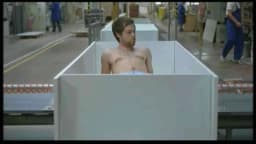
BBC Radio 4's William Shatner on Mars is a 3:31 animated short by Aardman, directed by Danny Capozzi, created to launch the broadcaster's March 2017 Mars

BBC Radio 4 Sends William Shatner to Mars in Aardman Animated Short
BBC Radio 4's "William Shatner on Mars" is a three-minute-and-thirty-one-second animated short film produced by Aardman, directed by Danny Capozzi, and narrated by William Shatner, created in March 2017 in the United Kingdom to serve as the visual identity for BBC Radio 4's Mars programming season.
BBC Radio 4 planned a dedicated Mars season running from 4 to 12 March 2017, according to Clapboard. To give the season a visual and tonal identity that would reach beyond the radio medium itself, the broadcaster commissioned Aardman — the Bristol-based studio internationally recognised for its animation heritage — to produce a short film capable of standing alone as a creative artefact. The result was a single film asset that combined live action, collage, hand-crafted animation, vintage typography, music, and the unmistakable voice of William Shatner into one cohesive promotional piece.
In the United Kingdom, BBC Radio 4 occupies a distinctive position as a speech-led public broadcasting service, and the Mars season represented an ambition to bring serious scientific subject matter to a broad audience through imaginative storytelling. The campaign's objective was both promotional and editorial — it needed to signal the tone of the season while generating anticipation across audiences who might not ordinarily tune in to factual radio programming. By placing William Shatner, a figure whose cultural identity is inseparable from space exploration in the popular imagination, at the centre of the narrative, BBC Radio 4 created an immediate and legible entry point into what was otherwise a dense scientific topic. The film was published and reported publicly on 7 March 2017, as noted by Animation World Network.
BBC Radio 4 commissioned Aardman just ten weeks before production began, according to Clapboard. That compressed timeline shaped the strategic logic of the campaign from the outset, demanding a creative approach that could be executed with speed and precision while still carrying the weight of a major broadcaster's seasonal launch.
The strategic insight underpinning "William Shatner on Mars" is rooted in cultural accessibility. Mars as a subject carries enormous scientific complexity, but it also carries decades of popular mythology — pulp fiction paperbacks, 1950s B-movies, and the golden age of science fiction broadcasting. BBC Radio 4's decision to lean into that mythology rather than position the season as purely educational reflects an understanding that emotion and nostalgia lower the barrier to entry for audiences who might feel excluded by hard science content. William Shatner functions not merely as a narrator but as a vessel for collective memory, his voice carrying the resonance of Star Trek and half a century of cultural association with the cosmos.
In the United Kingdom, public broadcasting faces sustained competitive pressure from streaming platforms including Netflix and Amazon Prime Video, both of which invest heavily in original factual and entertainment content. Against that backdrop, BBC Radio 4's ability to mobilise a figure of Shatner's international stature for a radio season launch demonstrates a form of creative leverage that purely digital competitors find difficult to replicate. The UK entertainment and media market was a substantial and growing sector in 2017, according to Consultancy Uk, underscoring the intensity of the competitive environment in which BBC Radio 4 was operating. The campaign positioned the broadcaster not as a legacy institution but as one capable of generating genuinely cinematic creative work in service of audio storytelling.
Danny Capozzi directed "William Shatner on Mars" for Aardman, delivering a film that Animation World Network described as a "stunning animation" and a "bold pulp-fiction style animated short" upon its publication on 7 March 2017.
The creative execution draws deliberately and lovingly from the visual grammar of 1950s B-movies and pulp science fiction comics. Capozzi and the Aardman team employed a low-fi cut-out animation technique that gives the film its handmade, tactile quality — a deliberate aesthetic choice that distances the work from the glossy computer-generated imagery that dominates contemporary animation production. Vintage-style typography punctuates the visual rhythm of the piece, reinforcing the retro sensibility while also serving a practical function: grounding factual information about Mars within a playful, readable graphic language.
The film operates in what might be described as a retro mash-up mockumentary format, blending the registers of documentary seriousness and genre pastiche simultaneously, as noted by Clapboard. This tonal duality is precisely calibrated to BBC Radio 4's audience, which tends to be both intellectually engaged and receptive to wit. William Shatner's narration sits at the centre of that balance — delivered with the knowing gravitas of a man entirely comfortable with the mythology that surrounds him.
The production brought together live action footage, collage elements, hand-crafted animation, music composition, and Shatner's voiceover into a unified 3:31 runtime, according to Animation World Network. That runtime is notably generous for a promotional film, suggesting that BBC Radio 4 and Aardman prioritised creative completeness over the compressed formats typical of broadcast advertising. The film functions as a short work of entertainment in its own right, not merely as a promotional trailer.
No verified performance data for "William Shatner on Mars" is publicly available in terms of audience reach, conversion to listenership, or measurable impact on BBC Radio 4's Mars season ratings.
Structural analysis of the campaign, however, points to several indicators of creative effectiveness. Animation World Network provided a positive editorial response at launch, characterising the film as "stunning" — a signal that the work achieved critical recognition within the animation and media industry at the time of release. That form of earned media attention, particularly from a specialist publication with an international readership, extends the campaign's reach beyond the BBC's own distribution channels without additional media spend.
The decision to produce a 3:31 film rather than a conventional promotional clip reflects confidence in the creative material and in the audience's willingness to engage with longer-form content. In the United Kingdom, where BBC Radio 4 commands a loyal and attentive listenership, that confidence is strategically reasonable. The campaign's greatest structural strength lies in the coherence between its form and its message: a retro-styled animated film narrated by one of science fiction's most recognisable voices is itself an argument for the imaginative ambition of the Mars season it promotes.
Clapboard assigns "William Shatner on Mars" a score of 67 out of 100, reflecting a campaign that demonstrates genuine creative distinction and intelligent casting but for which broader performance verification remains unavailable.
"William Shatner on Mars" is a 3:31 animated short film produced by Aardman and directed by Danny Capozzi for BBC Radio 4 in March 2017 in the United Kingdom. It served as the visual identity for the broadcaster's Mars season, which ran from 4 to 12 March 2017, using William Shatner's narration and a retro 1950s B-movie animation style.
Danny Capozzi directed "William Shatner on Mars" for Aardman. The film was commissioned by BBC Radio 4 approximately ten weeks before production began, according to Clapboard. Capozzi led a creative approach that combined low-fi cut-out animation, vintage typography, collage, and William Shatner's voiceover into a unified short film.
BBC Radio 4 selected William Shatner because his cultural identity is inseparable from space exploration and science fiction in the popular imagination. His narration provided immediate audience recognition and tonal credibility for the Mars season, lowering the barrier to entry for listeners who might find purely scientific programming less accessible.
The film uses a low-fi cut-out animation technique referencing 1950s B-movies and pulp science fiction comics, as noted by Clapboard. Aardman combined this with vintage typography, collage, live action elements, and music into a retro mash-up mockumentary format that Animation World Network described as a "bold pulp-fiction style animated short."
Clapboard assigns "William Shatner on Mars" a score of 67 out of 100. The score reflects a campaign that demonstrates genuine creative distinction and intelligent casting. No verified audience performance data for the campaign is publicly available, which limits a fuller quantitative assessment of its overall impact.
"William Shatner on Mars" was released in the United Kingdom in March 2017, with Animation World Network reporting on the film on 7 March 2017. It was created to launch BBC Radio 4's Mars season, which ran from 4 to 12 March 2017, and was produced by Aardman under the direction of Danny Capozzi.
.webp)
Creative Collaboration Platform: The Backbone of Modern Creative WorkWhat is a creative collaboration platform?Clapboard defines a creative collaboration platform as the operational core for today’s distributed creative teams. This is not a collection of digital collaboration tools stitched together; Clapboard’s system


Understanding the Creative Production MarketplaceWhat is a Creative Production Marketplace?Clapboard defines a creative production marketplace as a structured ecosystem where brands, agencies, and production talent converge to execute video, advertising, and branded content at scale. Unlike the legacy agency or freelanREAD FULL ARTICLE

The Urgent Need for a Creative Production Operating SystemWhy Traditional Creative Production Models Break DownClapboard sees the creative production landscape shifting under pressure. Content velocity is no longer a buzzword—it’s a mandate. Modern advertising demands relentless output across dozens of channels, each wREAD FULL ARTICLE