CBC's Strange Empire 'Three Women' campaign launched in the United States in October 2014, promoting a female-led Western drama set on the 1869 Alberta–Montana

CBC Strange Empire Puts Women in Charge of the Western Frontier
Strange Empire is a CBC drama series promoted in the United States in October 2014 through a film campaign titled "Three Women," positioning the show as a Western whose heroes are women surviving on the 1869 Alberta–Montana border frontier after the men of their community are killed.
The campaign arrived at a precise moment in the television landscape when female-led genre drama was beginning to earn serious commissioning attention across North American networks. CBC used a single-asset film campaign, published in the United States in October 2014, to introduce audiences to a series that departed sharply from the conventions of the Western genre. Where the classic frontier story centres male protagonists, Strange Empire placed three women at the core of its survival narrative, set against the unforgiving terrain of the Alberta–Montana border in 1869. The series premiered on October 6, 2014, as confirmed by Wikipedia, anchoring the campaign's release window to a tight pre-premiere push.
The campaign's geographic reach into the United States signalled CBC's ambition to position Strange Empire beyond its Canadian broadcast home and attract cross-border attention for a series that creator Laurie Finstad-Knizhnik developed as an explicitly female-driven dramatic vision. The principal cast — Cara Gee as Kat Loving and Melissa Farman among the leads, as documented across CBC and press sources — gave the campaign recognisable faces to carry a premise built on subversion: women not as background figures in a frontier town, but as its moral and narrative centre. Clapboard scores the campaign 64 out of 100, reflecting its strong conceptual clarity and culturally pointed positioning against a backdrop of limited documented reach data.
 ARCHIVE
Strange Empire addresses a structural gap in the Western genre. Where competitors such as AMC's Hell on Wheels and WGN America's Salem occupied different corners of prestige period drama in the United States during the 2014–15 television season, neither centred its narrative on women as primary agents of survival and power in a frontier setting. CBC recognised that positioning and built the campaign's entire identity around it.
The strategic rationale drew directly from the series' premise. Cara Gee, speaking to TV-Eh in October 2014, articulated the distinction plainly: "It's from a female point of view, and a lot of Westerns tend to be a male perspective." That creative truth became the campaign's organising principle, allowing the "Three Women" film to function simultaneously as a genre statement and a character introduction. Creator Laurie Finstad-Knizhnik described CBC as a broadcaster willing to "go out on a limb," suggesting the campaign was supported by institutional confidence in the series' unconventional direction.
The broader media environment in 2014 provided context for the ambition. Global advertising spending that year was estimated at between US$516 billion and US$524 billion, according to The Media Leader and NextTV, with digital formats accounting for a growing proportion of that total. In the United States specifically, the television drama market was experiencing a period of expansion driven by prestige cable and emerging streaming platforms. Against that competitive noise, a single, well-defined film asset built around a clear proposition — women in charge of a frontier town — offered CBC a focused way to cut through without requiring a large-format media buy in the US market.
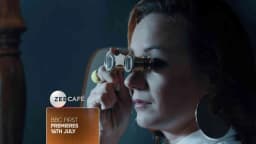
The "Three Women" campaign communicates its premise through visual and narrative economy. The film format, as archived by Clapboard, uses the series' own dramatic footage to construct a campaign asset that doubles as a trailer, allowing the production values of Strange Empire itself to do the persuasive work. The Alberta landscape — rendered as the 1869 frontier — provides an immediately legible Western iconography that the campaign then recontextualises by foregrounding its women protagonists.
Melissa Farman, speaking to CityNews and The Canadian Press on October 2, 2014, offered a formulation that captures the campaign's creative tension precisely: "We are definitely in distress, but by no means are we damsels." Cara Gee extended that thought on the same occasion, describing the characters as "damned selves in distress" — a rhetorical inversion that the film campaign appears designed to embody visually. The language used by the cast in press interviews maps directly onto the tonal register the campaign projects: danger acknowledged, agency asserted.
Production credits for the "Three Women" campaign are not publicly documented. The agency responsible for the campaign has not been disclosed, and no director, copywriter, or creative director is identified in any available trade or press source. CBC uploaded a Strange Empire trailer to its channels on September 26, 2014, according to records on Apple TV and CBC's own platform, ahead of the October 6 premiere — a sequencing that suggests the "Three Women" film was deployed as part of a coordinated pre-launch release strategy rather than a standalone isolated asset. The craft decision to let the series speak for itself, rather than constructing a separate brand campaign around it, reflects a disciplined and cost-efficient approach to genre positioning in the United States market.
No verified performance data for the "Three Women" campaign is publicly available. No sales lift, audience acquisition attribution, or campaign-specific engagement metrics have been located in any trade, press, or industry source. The campaign has not been recognised with awards at Cannes Lions, the Effies, the One Show, D&AD, the Clios, the Webby Awards, or WARC, based on available records.
Strange Empire premiered on October 6, 2014, drawing 319,000 Canadian viewers for its first episode, according to Ranker and corroborating sources. That figure, while modest by major-network standards, represented a launch audience for a deliberately unconventional drama on a public broadcaster — context that matters when evaluating what the campaign was asked to do. In the United States, where the campaign was published, no equivalent audience data for the premiere has been located in publicly available sources.
Structurally, the campaign demonstrates several qualities that support effectiveness as a launch tool. The single-asset film format concentrates investment into one clear statement. The campaign's conceptual hook — three women, frontier town, survival — is specific enough to be memorable and differentiated enough to avoid confusion with competing period dramas active in the United States market at the same time. The casting of Cara Gee and Melissa Farman as recognisable faces in pre-launch press, aligned with the film's release, created a coherent earned-media layer around the paid campaign asset. These are structural markers of a campaign built with intent, even where documented results remain absent.
The "Three Women" campaign is a 2014 film advertisement promoting Strange Empire, a CBC drama series. Published in the United States in October 2014, it introduces a Western set on the 1869 Alberta–Montana border where three women become the central figures of survival after the men of their frontier community are killed.
Strange Empire premiered on October 6, 2014, according to Wikipedia. The "Three Women" campaign was published in the United States in October 2014, timed to coincide with the series launch. CBC uploaded a trailer on September 26, 2014, as part of a coordinated pre-premiere release strategy across its platforms.
Strange Empire stars Cara Gee as Kat Loving and Melissa Farman among its principal cast. Both actors spoke publicly about the series ahead of its October 2014 premiere, with Farman telling CityNews and The Canadian Press that the characters are "definitely in distress, but by no means damsels," a statement that reflects the campaign's core positioning.
Strange Empire centres three women as its primary agents of survival in a frontier town, a distinction Cara Gee described to TV-Eh in October 2014 as a deliberate female point of view. Competing period dramas in the United States market at the time, including AMC's Hell on Wheels, maintained predominantly male-led narrative frameworks in the Western genre.
Clapboard scores the Strange Empire "Three Women" campaign 64 out of 100. The score reflects the campaign's strong conceptual clarity and culturally specific positioning as a female-led Western, balanced against the absence of publicly documented performance data, agency credits, or verified award recognition for the 2014 United States campaign.
The agency responsible for the Strange Empire "Three Women" campaign has not been publicly disclosed. No director, copywriter, or creative director is identified in any available trade or press record. Creator Laurie Finstad-Knizhnik developed the Strange Empire series itself, with CBC acting as the commissioning broadcaster and brand behind the October 2014 United States campaign.
.webp)
Creative Collaboration Platform: The Backbone of Modern Creative WorkWhat is a creative collaboration platform?Clapboard defines a creative collaboration platform as the operational core for today’s distributed creative teams. This is not a collection of digital collaboration tools stitched together; Clapboard’s system


Understanding the Creative Production MarketplaceWhat is a Creative Production Marketplace?Clapboard defines a creative production marketplace as a structured ecosystem where brands, agencies, and production talent converge to execute video, advertising, and branded content at scale. Unlike the legacy agency or freelanREAD FULL ARTICLE

The Urgent Need for a Creative Production Operating SystemWhy Traditional Creative Production Models Break DownClapboard sees the creative production landscape shifting under pressure. Content velocity is no longer a buzzword—it’s a mandate. Modern advertising demands relentless output across dozens of channels, each wREAD FULL ARTICLE