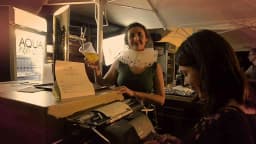
CCBEU Turns a Cinema Lobby Into an English Lesson
CCBEU's "Trailer" is a 2013 ambient campaign created by Goiânia-based agency Zebrabold that ambushed cinema audiences in Brazil with an unexpected activation in the moments immediately before a film screening, using the encounter to prompt viewers to reconsider enrolling in an English course.
The campaign operates on a single, precisely timed idea. Cinema audiences arrive expecting a commercial trailer — the kind of media asset that belongs naturally in that pre-film window — and instead encounter a surprise scenario engineered by CCBEU that reframes the experience as a demonstration of why English fluency matters, according to Trycrush. The ambient medium is not incidental to the concept; it is the concept. The placement inside a cinema, a space audiences associate with narrative and entertainment rather than advertising, lends the activation a credibility and memorability that a conventional television or print execution could not replicate, according to Br Usembassy Gov. As documented by Clapboard, the campaign was published in February 2013 and contains one media asset, making it a tightly focused creative bet on a single moment of contact, according to Britishcouncil Org Br.
In Brazil, where the private English-language education sector was competitive and growing at the time, CCBEU needed a way to stand out against larger, nationally franchised competitors. The choice of an ambient campaign over a mass-media buy reflects a strategic preference for depth of impression over breadth of reach. By intercepting audiences inside a cinema — a high-attention, low-distraction environment — the brand created the conditions for genuine surprise, the core emotional mechanism the campaign relies upon, according to LinkedIn. The narrative genre conventions of the cinema space, specifically the expectation of a trailer, become the raw material the creative team at Zebrabold shapes into an education message. The result is a campaign that earns its audience's attention rather than buying it outright.
CCBEU operates in one of the most contested English-language education markets in Latin America. According to British Council research, approximately 43.3 million Brazilians — representing around 21.3 percent of the population at the time — were English learners or potential learners, with approximately 2.5 million enrolled in private English-language training. That scale of latent demand made Brazil an attractive but crowded market for any English course provider.
The competitive pressure was substantial. Grupo Multi, owner of the Wizard, Yázigi, Microlins, and Skill brands, was Brazil's largest private language-school operator, serving more than 800,000 students through over 2,600 franchised schools, according to reporting by Valor Internacional. CCAA, another nationally recognised brand, maintained a similarly broad footprint. Against competitors with that kind of distribution and marketing infrastructure, a regional institution like CCBEU — headquartered in Goiânia — could not win on media weight alone. The strategic logic of the Trailer ambient campaign follows directly from this constraint. Rather than attempting to match larger rivals through conventional advertising spend, Zebrabold identified a moment of genuine consumer receptivity — the pre-film silence inside a cinema — and built an education message around it, according to Adwhispr.
The surprise campaign mechanic is a deliberate response to the saturation of the English course category in Brazil in 2013. When every competitor is making broadly similar promises about fluency and career advancement, the brand that disrupts the expected frame of reference earns disproportionate attention. The cinema environment also self-selects an audience: people who attend films in Brazil tend to skew toward the urban, aspirational demographic that English-language education providers most want to reach. The ambient medium and the target audience align without the brand having to force the connection.
Zebrabold anchored the creative execution in the narrative genre conventions of the cinema trailer format. The campaign was directed and produced with the production company Tubo Filmes, and the video and photography work was handled by Brynner Caldas and Rafael Borges, as documented by Clapboard. The creative direction was shared across Anderson Pádua, Gabriel Godinho, and Rafael Paranaíba, with art direction credited to Gabriel Godinho and Rafael Paranaíba, and the copywriting attributed to Tárik Hermano.
The craft challenge in an ambient campaign of this kind is tonal precision. The activation must feel surprising without feeling deceptive, and it must land the education message without lecturing an audience that has paid to be entertained rather than sold to. The creative team at Zebrabold resolved this by working with the cinema environment rather than against it. The familiar rhythms of a pre-film trailer — the specific pacing, the visual language, the expectation of narrative — become the vehicle through which the CCBEU message is delivered. The surprise is not simply that an ad appears where an ad is unexpected; it is that the ad uses the audience's own cinematic fluency against them, making the case for English comprehension through direct, lived experience rather than assertion.
The campaign consists of one media asset, as documented by Clapboard, which concentrates the entire creative and strategic argument into a single execution. This economy of means is itself a craft decision. A more expansive campaign might have diluted the purity of the ambient concept by extending it into formats where the surprise mechanism cannot operate. By committing to one precisely placed piece of work, the Zebrabold team preserved the integrity of the idea and ensured that the narrative genre surprise at its centre landed without redundancy.
No verified performance data for the CCBEU Trailer campaign is publicly available. As documented by Clapboard, no published business results, sales lift, enrollment growth, market-share data, brand-awareness metrics, or return-on-investment figures have been released. The campaign received no documented awards across Cannes Lions, the Effies, The One Show, D&AD, the Clios, the Webby Awards, or WARC Awards, per Clapboard's records.
Structural analysis, however, supports a reasonable assessment of the campaign's effectiveness as a piece of ambient communication. The core mechanism — a surprise activation in a high-attention environment timed to coincide with a moment of genuine audience receptivity — is well suited to generating the kind of emotional encoding that drives brand recall. Research into experiential advertising consistently finds that surprise and context congruence, both present in this execution, are among the strongest predictors of memory retention. The campaign's single-asset discipline also means that its creative idea had to be fully resolved rather than spread across multiple executions, which typically produces stronger individual impressions.
The Trailer campaign earns a Clapboard Score of 69 out of 100. That score reflects genuine creative ingenuity in the ambient format and a strategically sound use of narrative genre conventions, tempered by the absence of any verifiable impact data and the limited scale implicit in a single-asset, single-market execution in Goiânia, Brazil in 2013. The campaign is a confident piece of local creative work that demonstrates how a regional English course provider can compete for attention without matching the media budgets of nationally franchised competitors.
CCBEU's Trailer is a 2013 ambient campaign created by Zebrabold in Goiânia, Brazil. It placed a surprise activation immediately before a film screening in a cinema, using the pre-film moment to prompt audiences to reconsider enrolling in an English course. The campaign consists of one media asset, as documented by Clapboard.
Zebrabold, a Goiânia-based Brazilian advertising agency, created the Trailer campaign for CCBEU. The creative team included creative directors Anderson Pádua, Gabriel Godinho, and Rafael Paranaíba, copywriter Tárik Hermano, and video contributors Brynner Caldas and Rafael Borges, with production handled by Tubo Filmes, per Clapboard.
CCBEU chose an ambient approach to compete with larger rivals like Grupo Multi and CCAA without matching their media budgets. By placing a surprise activation inside a cinema — a high-attention, low-distraction environment — the brand could generate deeper impressions among the urban, aspirational audience most likely to consider an English course in Brazil.
Brazil's private English-language education sector was highly competitive in 2013. According to British Council research, approximately 43.3 million Brazilians were English learners or potential learners. Grupo Multi alone served more than 800,000 students through over 2,600 franchised schools, according to Valor Internacional, making differentiation essential for regional providers like CCBEU.
The CCBEU Trailer campaign did not receive documented awards. Per Clapboard, no recognition has been recorded across Cannes Lions, the Effies, The One Show, D&AD, the Clios, the Webby Awards, or WARC Awards. The campaign nonetheless earns a Clapboard Score of 69 out of 100 for its strategic use of the ambient format.
The CCBEU Trailer campaign receives a Clapboard Score of 69 out of 100. The score recognises genuine creative ingenuity in deploying the ambient format and the narrative genre surprise mechanic, while reflecting the absence of verifiable performance data and the limited scale of a single-asset execution in the Brazilian market in 2013.
.webp)
Creative Collaboration Platform: The Backbone of Modern Creative WorkWhat is a creative collaboration platform?Clapboard defines a creative collaboration platform as the operational core for today’s distributed creative teams. This is not a collection of digital collaboration tools stitched together; Clapboard’s system


Understanding the Creative Production MarketplaceWhat is a Creative Production Marketplace?Clapboard defines a creative production marketplace as a structured ecosystem where brands, agencies, and production talent converge to execute video, advertising, and branded content at scale. Unlike the legacy agency or freelanREAD FULL ARTICLE

The Urgent Need for a Creative Production Operating SystemWhy Traditional Creative Production Models Break DownClapboard sees the creative production landscape shifting under pressure. Content velocity is no longer a buzzword—it’s a mandate. Modern advertising demands relentless output across dozens of channels, each wREAD FULL ARTICLE