 ARCHIVE
DIRTEA Chai Brings Functional Mushrooms to British Wellness Culture
How DIRTEA Chai Fuses Ayurvedic Tradition With Functional Mushroom Science DIRTEA Chai is a...
Garden of Life Bets on Taste to Reframe Plant Protein
Garden of Life's Bringing Tasty Back campaign, created with Humanaut and launched in the United States on January 16, 2023, is a pair of 15-second video spots that reframe organic plant protein as genuinely delicious, running across Roku, Meta, Amazon Prime, and YouTube.
Garden of Life occupies a distinctive position in the competitive US organic nutrition market. The brand holds carbon-neutral certification and carries both USDA Organic and Non-GMO Project Verified status across its product range — credentials that, as noted in Clapboard's editorial analysis, speak to a company whose identity is built as much on what it excludes from formulations as on what it includes. No synthetic ingredients, no artificial flavours or colourings, no binders or fillers appear in its products. The Bringing Tasty Back campaign, however, was not commissioned to relitigate those quality credentials. Its singular job, as described in coverage published by MediaPost's Marketing Daily on January 25, 2023, was to solve a different problem: convincing consumers that plant-based protein shakes from Garden of Life actually taste good.
The campaign in the United States spans three products. Organic Creamy Protein with Oatmilk is an entirely new SKU introduced alongside the campaign. Raw Organic Meal and Raw Organic Protein are reformulated updates to existing lines, their recipes refined before the creative work was built around them. Print, social, and display assets supporting the campaign were produced by Garden of Life's own in-house creative team, with Humanaut responsible for the two hero video executions. The Clapboard Score for Bringing Tasty Back is 60 out of 100, reflecting a campaign that executes its narrow creative brief competently but operates within a deliberately constrained strategic ambition.
Garden of Life identified a persistent credibility gap in the plant protein category in the United States. The strategic insight animating Bringing Tasty Back is straightforward: organic and plant-based protein supplements have long been associated with virtuous ingredients and poor palatability, and that association functions as a genuine purchase barrier even among health-conscious consumers already predisposed to the category.
The scale of the market makes that barrier commercially significant. According to Grand View Research, the global plant-based protein supplements market was valued at approximately two point six five billion dollars in 2023, with North America representing roughly forty point nine percent of global revenue — implying a regional market of approximately one point zero nine billion dollars, also per Grand View Research. Within that landscape, Garden of Life competes directly with brands such as Orgain, which built its US market presence on accessible flavour positioning, and Vega, which has historically led with performance and ingredient transparency messaging. Neither competitor has made taste the centrepiece of a major campaign in the way Bringing Tasty Back attempts to do, which is the strategic ground Garden of Life is claiming.
David Littlejohn, Humanaut's founder and chief creative director, described the brief as an opportunity to highlight taste in a space where plant-based protein is not ordinarily associated with deliciousness, as reported by MediaPost. That framing shaped every executional decision. Rather than constructing a comparative claim that would require substantiation, the campaign routes its argument through consumer imagination — letting the audience's own preconceptions about bad plant protein flavour do the persuasive heavy lifting before Garden of Life's products resolve the tension.
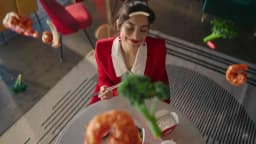
Humanaut built both 15-second spots around a single visual conceit. Each spot features one consumer — a man in one execution, a woman in the other — mentally picturing what a competing plant-based protein shake must taste like, expressed through a sequence of absurdist flavour pairings rendered as physical objects.
For the male character, those imagined flavours materialise as chocolate cardboard, vanilla sidewalk chalk, and berry beach doormat sand. For the female character, the sequence produces peanut butter and baking soda, mocha drywall, and cookies and cream couch cushion crumbs. The specificity of each pairing is the craft at work: the descriptors are grounded enough in real category flavour profiles — chocolate, vanilla, berry, mocha, cookies and cream — that they read as credible indictments rather than absurdist non-sequiturs. The non-edible counterpart in each pair carries just enough textural plausibility to trigger genuine aversion. Both spots resolve as each character tastes their Garden of Life shake and registers visible relief, landing on the campaign line Bringing Tasty Back.
David Littlejohn of Humanaut served as the creative lead on the video executions, as documented in coverage by MediaPost. Production credits for the broader Bringing Tasty Back campaign beyond Littlejohn's creative direction are not publicly documented. The print, social, and display assets — which extended the campaign's visual vocabulary across paid and owned channels — were produced entirely by Garden of Life's in-house creative team, keeping the supporting layer of the campaign architecturally consistent with the hero spots without requiring an external production resource for each asset type. The campaign launched simultaneously across Roku, Meta, Amazon Prime, and YouTube, distributing the 15-second format across both connected television and digital social environments in the United States.
No independently verified performance data for the Bringing Tasty Back campaign — including sales lift, view counts, recall scores, or share-of-voice movement — is publicly available at the time of this analysis. No industry award recognitions for the campaign have been documented in publicly accessible sources.
Structural analysis of the campaign's effectiveness reveals a narrow but coherent execution. The decision to run 15-second spots on Roku and Amazon Prime places the creative in a connected-television environment where completion rates typically favour shorter formats, and where the target audience of health-conscious US consumers over-indexes relative to linear television, as Clapboard's editorial analysis notes. The choice to anchor the humour in consumer-imagined flavour scenarios rather than explicit competitive comparison avoids the regulatory and substantiation risks that direct comparative advertising in the food and supplement category carries in the United States.
The campaign's structural limitation, and the principal reason for a Clapboard Score of 60 out of 100, is the narrowness of its strategic register. Bringing Tasty Back addresses a real purchase barrier — taste scepticism around plant protein and organic meal replacement — but it does so without connecting that taste narrative to Garden of Life's most defensible brand assets: its carbon-neutral certification, its USDA Organic credentials, and its Non-GMO Project Verified status. A campaign that unified taste and provenance into a single creative argument would have been considerably harder for competitors such as Orgain or Vega to replicate on either dimension alone.
Bringing Tasty Back is a 2023 Garden of Life campaign created with Humanaut. It launched on January 16, 2023 in the United States across Roku, Meta, Amazon Prime, and YouTube. Two 15-second spots use humour to position Garden of Life's plant protein and Raw Organic Meal products as genuinely great-tasting alternatives to the broader category.
Bringing Tasty Back spotlights three Garden of Life products. Organic Creamy Protein with Oatmilk is a new SKU introduced alongside the campaign. Raw Organic Meal and Raw Organic Protein are reformulated existing products whose updated recipes were the direct creative trigger for the Bringing Tasty Back campaign, as reported by MediaPost.
Humanaut created the two 15-second video spots, with David Littlejohn, Humanaut's founder and chief creative director, leading the creative work. Garden of Life's in-house creative team produced all supporting print, social, and display assets. The campaign represents a collaboration between an external agency and an internal team, as reported by MediaPost.
Each spot shows a consumer imagining a competitor's plant protein shake as an unpleasant object — chocolate cardboard, vanilla sidewalk chalk, mocha drywall, or cookies and cream couch cushion crumbs. The character then tastes Garden of Life's product and finds it genuinely good, resolving on the tagline Bringing Tasty Back.
Bringing Tasty Back earns a Clapboard Score of 60 out of 100. The campaign executes its core taste-focused brief competently across connected television and digital channels in the United States, but does not connect the taste narrative to Garden of Life's strongest brand credentials, including its carbon-neutral and USDA Organic certifications.
Bringing Tasty Back claims taste as Garden of Life's differentiating ground in the US plant protein market, a space where competitors such as Orgain and Vega have led with accessibility and performance messaging respectively. Rather than direct comparison, the campaign uses consumer-imagined flavour scenarios to imply category-wide taste deficiency without making explicit competitive claims.
.webp)
Creative Collaboration Platform: The Backbone of Modern Creative WorkWhat is a creative collaboration platform?Clapboard defines a creative collaboration platform as the operational core for today’s distributed creative teams. This is not a collection of digital collaboration tools stitched together; Clapboard’s system


Understanding the Creative Production MarketplaceWhat is a Creative Production Marketplace?Clapboard defines a creative production marketplace as a structured ecosystem where brands, agencies, and production talent converge to execute video, advertising, and branded content at scale. Unlike the legacy agency or freelanREAD FULL ARTICLE

The Urgent Need for a Creative Production Operating SystemWhy Traditional Creative Production Models Break DownClapboard sees the creative production landscape shifting under pressure. Content velocity is no longer a buzzword—it’s a mandate. Modern advertising demands relentless output across dozens of channels, each wREAD FULL ARTICLE