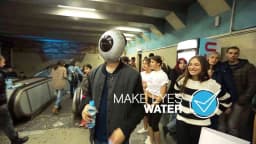
Jaz Amsterdam's 'Built by Music' ambient campaign, created by Jung von Matt/Neckar in June 2016, staged a live musical activation beside the Ziggo Dome to

Jaz Amsterdam Turns an Adele Concert Crowd Into a Hotel Launch
Jaz Amsterdam's 'Built by Music' is an ambient launch campaign created by Jung von Matt/Neckar in June 2016 that used a live musical activation staged beside Amsterdam's Ziggo Dome — capitalising on the arriving crowd for an Adele concert — to announce the grand opening of the first Jaz in the City hotel to a mass audience in a single, unrepeatable moment.
The Jaz Amsterdam hotel opened its doors officially on June 2, 2016, as reported by Hotel Designs, following a soft opening in November 2015. The property, situated directly adjacent to the Ziggo Dome — Amsterdam's largest concert venue — had a geographic identity inseparable from live music, and the brand chose to make that adjacency the centrepiece of its market entry. Rather than relying on conventional out-of-home advertising or a press event held behind closed doors, Jung von Matt/Neckar devised a single ambient execution consisting of one media asset: a staged performance designed to intercept concertgoers as they arrived for Adele's show, turning organic footfall into an audience for the hotel's debut.
The campaign was published in Germany in June 2016, positioning Stuttgart-based Jung von Matt/Neckar as the originating creative force behind a hotel brand operating in the Netherlands but developed under the Deutsche Hospitality and Steigenberger Hotels group. According to presseportal.de, the Jaz brand concept was developed from 2013 onward as a young lifestyle proposition anchored in music and local urban culture. At launch, the Amsterdam property comprised 247 rooms and 11 suites, as documented by All Accor. The 'Built by Music' activation was therefore not merely an advertising campaign but the first public statement of what the Jaz in the City brand stood for — and it staked that statement on a single evening's crowd.
Amsterdam's hospitality market was expanding rapidly at the precise moment Jaz entered it. According to HVS, the city held approximately 30,000 hotel rooms ahead of the 2016 expansion cycle, with roughly 4,000 additional rooms expected to open during that year alone — implying supply growth of approximately 13 percent against the existing room base, according to HVS. Hotel occupancy in Amsterdam reached 78.2 percent in 2015, rising by more than three percentage points year-on-year, and the average daily rate increased 8.3 percent in 2015 to €131, also according to HVS. PwC forecast occupancy of approximately 78 percent and an average daily rate of approximately €134 for 2016, with further rate growth to approximately €137 projected for 2017, per PwC's published hospitality outlook.
Into this competitive landscape — where established lifestyle hotel operators including NH Hotels and citizenM were already fighting for the design-conscious traveller — Jaz Amsterdam needed a positioning that neither price nor product alone could deliver. The Jaz in the City concept, as described by hmi-online.com, was built explicitly around music and neighbourhood culture, a differentiator that required creative proof rather than a brand promise. Jung von Matt/Neckar identified the Ziggo Dome's calendar as the most direct route to that proof: the venue draws the world's highest-profile touring artists, and its audiences self-select as exactly the culturally engaged travellers the Jaz brand was designed to attract. By staging the launch activation on the night of an Adele performance, the agency ensured that the crowd arriving at the Ziggo Dome was not a sampled demographic but a self-assembled congregation of the hotel's intended guests, encountering the Jaz brand for the first time in a context that made the music positioning immediately legible and credible.
The 'Built by Music' execution rests on the discipline of restraint. Jung von Matt/Neckar delivered a single media asset — a film of the activation — rather than a campaign spread across formats, trusting the specificity of the moment to carry the full weight of the brand idea. Directors Clemens Wittkowski and Fabian Grobe led the production in collaboration with Stink Berlin and Wink Amsterdam, bringing together two production houses whose combined footprint across Germany and the Netherlands mirrored the campaign's own cross-border identity. Sound design was handled by Bauhouse, whose contribution was structural rather than decorative: in a campaign where music is the entire argument, the sonic construction of the film had to perform without irony.
Creative directors Matthias Hess and Sven Kratzsch oversaw the campaign from Jung von Matt/Neckar's Stuttgart office, with art direction by Rico Noël and copy by Michael Maria Morgenbesser. The film and field production roles were carried by Darek Stoehr and Joshua Enzig, while choreographer Ish Amsterdam shaped the physical language of the activation itself — the performers moving through the arriving Ziggo Dome crowd rather than presenting to them from a stage. According to Hotel Designs, Joost van Beck served as band leader for the opening performance, grounding the event in live musicianship rather than playback, and DJ Fedde le Grand appeared as the headline attraction, as also reported by Hotel Designs. Producer Vivian Schröder coordinated the logistics of a live ambient event that, by its nature, could not be rehearsed in front of its actual audience. No verified direct quotes from the Jung von Matt creative team are publicly available. The result is an ambient piece that functions simultaneously as event, advertisement, and brand manifesto — recorded once and unrepeatable.
No verified performance data for the 'Built by Music' campaign is publicly available. No documented view counts, earned media reach figures, booking uplift metrics, or brand awareness studies have been attributed to this campaign by Jung von Matt/Neckar, Jaz, or any third-party measurement body in publicly accessible sources. The campaign's effectiveness must therefore be assessed on structural grounds.
The activation's structural strength lies in audience specificity and contextual credibility. By intercepting concertgoers outside the Ziggo Dome on the evening of Adele's performance, the campaign reached a self-selecting audience — culturally engaged, already primed for musical experience, and physically standing at the threshold of the hotel's location. This is the ideal condition for ambient media: zero wastage, maximum contextual relevance. The single-asset approach, documented by clapboard.com, concentrated all creative effort into one moment rather than distributing it across formats that would have diluted the lived experience of the activation. The involvement of a recognisable headline figure in DJ Fedde le Grand, as reported by Hotel Designs, extended the event's credibility beyond the hotel's own brand equity at a point when that equity was, by definition, still being established.
Clapboard rates 'Built by Music' at 74 out of 100, recognising the precision of its strategic targeting and the economy of its creative means while noting that the limitation to a single media asset constrains the campaign's measurable footprint beyond the activation itself.
'Built by Music' is an ambient campaign created by Jung von Matt/Neckar for Jaz Amsterdam in June 2016. It staged a live musical activation beside the Ziggo Dome to mark the hotel's grand opening, intercepting the crowd arriving for an Adele concert to introduce the Jaz in the City brand through direct experience.
Jung von Matt/Neckar created the campaign. Creative directors Matthias Hess and Sven Kratzsch led the work, with art direction by Rico Noël and copy by Michael Maria Morgenbesser. Directors Clemens Wittkowski and Fabian Grobe produced the film with Stink Berlin and Wink Amsterdam, and Darek Stoehr and Joshua Enzig handled field production.
Jaz Amsterdam sits directly adjacent to the Ziggo Dome, Amsterdam's largest concert venue. Jung von Matt/Neckar used that physical proximity to stage a live activation that made the hotel's music-first identity tangible rather than stated, reaching culturally engaged concertgoers — the precise audience the Jaz in the City brand was built to attract.
Jaz Amsterdam opened officially on June 2, 2016, as reported by Hotel Designs, following a November 2015 soft opening. The launch event featured a live performance beside the Ziggo Dome, with Joost van Beck as band leader and DJ Fedde le Grand as headline attraction, staged alongside an Adele concert at the adjacent venue.
Jaz in the City is a lifestyle hotel concept developed by Deutsche Hospitality and Steigenberger Hotels from 2013, anchored in music and local urban culture, as described by hmi-online.com. Where competitors such as citizenM and NH Hotels lead with design and price, Jaz positions music as a structural identity, not an amenity — a distinction the 'Built by Music' campaign was designed to prove.
Clapboard rates 'Built by Music' at 74 out of 100. The score reflects the campaign's strategic precision — a single ambient asset deployed at a moment of maximum audience relevance — balanced against the inherent reach limitations of a one-night, single-format activation with no documented third-party performance metrics.
.webp)
Creative Collaboration Platform: The Backbone of Modern Creative WorkWhat is a creative collaboration platform?Clapboard defines a creative collaboration platform as the operational core for today’s distributed creative teams. This is not a collection of digital collaboration tools stitched together; Clapboard’s system


Understanding the Creative Production MarketplaceWhat is a Creative Production Marketplace?Clapboard defines a creative production marketplace as a structured ecosystem where brands, agencies, and production talent converge to execute video, advertising, and branded content at scale. Unlike the legacy agency or freelanREAD FULL ARTICLE

The Urgent Need for a Creative Production Operating SystemWhy Traditional Creative Production Models Break DownClapboard sees the creative production landscape shifting under pressure. Content velocity is no longer a buzzword—it’s a mandate. Modern advertising demands relentless output across dozens of channels, each wREAD FULL ARTICLE