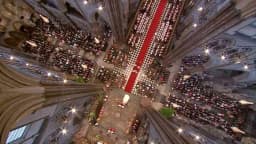
Mercedes-Benz and Amsterdam agency N=5 placed oversized stickers on Dutch rooftops in December 2011, creating ambient ads visible only from the elevated cab of

How Mercedes-Benz Turned Dutch Rooftops Into a Truck Driver's Billboard
Mercedes-Benz launched the Rooftop Stickers campaign in December 2011 in The Netherlands, working with Amsterdam agency N=5 to place oversized stickers on rooftops along truck routes, positioning advertising messages so they were visible exclusively from the elevated vantage point of a truck driver seated in the cab of the new Actros — a medium-specific, audience-specific ambient execution with no equivalent in conventional outdoor formats.
The campaign's premise is disarmingly simple and strategically precise. The new Actros is Mercedes-Benz's most impressive truck to that point, and the brand wanted truck drivers to experience its qualities in a place where only they could see it. Rather than broadcasting a product message to a general motoring audience through television, print, or standard roadside billboards, N=5 identified the unique sight-line of a professional truck driver as the medium itself. The rooftop stickers were engineered to disappear entirely for any observer at ground level — a passenger car driver, a pedestrian, a bystander — rendering the message invisible to everyone except the precise professional the new Actros was designed to serve.
In The Netherlands, a country with a dense logistics infrastructure and significant commercial trucking activity, rooftops along arterial routes and industrial corridors become legitimate advertising real estate when the target audience operates vehicles elevated several metres above road level. The campaign contains one documented media asset, reflecting the tight, single-idea discipline that characterises the strongest ambient work. The Clapboard Score for Rooftop Stickers is 71 out of 100, reflecting strong conceptual clarity and medium-specific originality, offset by limited documented reach and the absence of verified performance data.
Mercedes-Benz targets one of the most difficult professional audiences in automotive advertising: the working truck driver, who is not swayed by lifestyle imagery and who evaluates commercial vehicles against hard operational criteria including fuel economy, cab comfort, drivetrain reliability, and total cost of ownership.
The strategic insight underpinning the Rooftop Stickers campaign is that the truck cab itself is both a workspace and a vantage point unlike any other on a public road. N=5 leveraged this physical reality to create a channel that competitors including Volvo Trucks and Scania — both of whom contest the European heavy-duty segment aggressively with their own driver-centric communications — structurally cannot replicate without first adopting the same ambient logic. The message is not intercepting truck drivers; it is greeting them as insiders, acknowledging a perspective on the world that only they possess.
The European market context in 2011 made precision targeting particularly relevant. According to just-auto.com, the European market for trucks above fifteen tonnes was estimated at between 235,000 and 245,000 units in 2011, with sales expected to soften to between 225,000 and 250,000 units in 2012. In a market of that scale, with purchase decisions concentrated among fleet operators and owner-operators who respond to peer credibility rather than mass-media persuasion, an ambient campaign that speaks directly and exclusively to the driver carries a qualitative weight that raw impression numbers cannot capture. The new Actros would go on to be named International Truck of the Year 2012 by truck journalists from twenty-four European countries, as documented by mercedes-benz-trucks.com — an editorial endorsement that the Rooftop Stickers campaign preceded and contextually reinforced in The Netherlands.
Ed van Bennekom served as art director on the Rooftop Stickers campaign, with Paul Bakker and Jasper Diks as copywriters and Reza Harek as photographer — a lean creative team whose work distils a product truth into a single, unrepeatable physical encounter.
The craft challenge in an ambient campaign of this kind is not primarily graphic. It is spatial and perceptual. The sticker artwork had to be calibrated for legibility at the precise elevation and distance from which an Actros driver would encounter it, accounting for the angle of sight from a cab positioned several metres above the road surface. Any miscalculation in scale, contrast, or placement would collapse the illusion and reduce the execution to a curiosity rather than a communication. The fact that the campaign was documented and circulated — across platforms including adruby.com and worldvideoads.com — indicates the execution was sufficiently convincing to generate organic interest among advertising professionals and enthusiasts who encountered it secondhand, through the single media asset that constitutes the campaign's documented record.
The copywriting task is equally constrained by the medium. A rooftop sticker must communicate instantly, in the peripheral rhythm of a moving vehicle, with no opportunity for a second reading. Bakker and Diks would have been working within the tightest conceivable word-count discipline. Harek's photography documents the execution in a way that makes the concept legible to audiences who will never see the stickers from a truck cab — a secondary communication layer that extends the campaign's life beyond its physical installation in The Netherlands and into the wider advertising conversation.
No verified performance data for the Rooftop Stickers campaign is publicly available. No sales lift, market-share change, lead generation figures, dealer inquiry volumes, test-drive conversions, brand-tracking shifts, or awareness metrics have been published by Mercedes-Benz, N=5, or any third-party research body, as confirmed by review of selfstorming.com, mercedes-benz-trucks.com, Theworldofmbamg Wordpress, Group Mercedes-Benz, and daimlertruck.com.
No verified awards for the Rooftop Stickers campaign are recorded across Cannes Lions, the Effies, the One Show, D&AD, Clio, the Webby Awards, or WARC. The absence of a formal awards trail does not diminish the campaign's structural intelligence, but it does limit the external validation available for assessment.
What the campaign achieves structurally is demonstrable. It creates a one-to-one encounter with its target audience — the professional truck driver — in a context where no competing message can intrude. It activates the product's core proposition, the driver experience of the new Actros, through the act of reception itself: the driver who reads a rooftop sticker is, at that moment, experiencing a point of view that the Mercedes-Benz Actros makes uniquely possible. The medium is the message in the most literal sense. The new Actros was subsequently named International Truck of the Year 2012, according to mercedes-benz-trucks.com, affirming the product quality the campaign sought to dramatise. The Clapboard Score of 71 out of 100 reflects a campaign that earns high marks for conceptual originality and medium-specific discipline while being constrained by its single-asset scale and the absence of documented reach or effectiveness data.
The Rooftop Stickers campaign was an ambient advertising initiative created by Amsterdam agency N=5 for Mercedes-Benz in December 2011. Large stickers were placed on rooftops in The Netherlands at positions and angles visible only from the elevated cab of the new Actros truck, targeting professional truck drivers exclusively.
N=5, an Amsterdam-based advertising agency, created the campaign. The documented creative team includes Ed van Bennekom as art director, Paul Bakker and Jasper Diks as copywriters, and Reza Harek as photographer. The campaign was published in The Netherlands in December 2011 for the launch of the new Mercedes-Benz Actros.
Mercedes-Benz wanted truck drivers to experience the new Actros in a place only they could see. The elevated cab of the Actros gives drivers a unique sight-line above standard traffic. N=5 used this physical vantage point to create an ambient message invisible to all other road users, making the medium itself a product demonstration.
The campaign ran in The Netherlands in December 2011. The exclusive target audience was professional truck drivers operating the new Mercedes-Benz Actros. Stickers were placed on rooftops along routes accessible to heavy commercial vehicles, ensuring the ambient messages reached only the professional drivers the new Actros was designed to serve.
No verified awards for the Rooftop Stickers campaign are recorded at Cannes Lions, the Effies, the One Show, D&AD, Clio, the Webby Awards, or WARC. The new Actros truck itself, however, was named International Truck of the Year 2012 by journalists from twenty-four European countries, according to mercedes-benz-trucks.com.
The Rooftop Stickers campaign receives a Clapboard Score of 71 out of 100. The score reflects strong conceptual originality and precise medium-specific thinking in its Dutch ambient execution, offset by its single-asset scale and the absence of publicly verified performance or effectiveness data from Mercedes-Benz or agency N=5.
.webp)
Creative Collaboration Platform: The Backbone of Modern Creative WorkWhat is a creative collaboration platform?Clapboard defines a creative collaboration platform as the operational core for today’s distributed creative teams. This is not a collection of digital collaboration tools stitched together; Clapboard’s system


Understanding the Creative Production MarketplaceWhat is a Creative Production Marketplace?Clapboard defines a creative production marketplace as a structured ecosystem where brands, agencies, and production talent converge to execute video, advertising, and branded content at scale. Unlike the legacy agency or freelanREAD FULL ARTICLE

The Urgent Need for a Creative Production Operating SystemWhy Traditional Creative Production Models Break DownClapboard sees the creative production landscape shifting under pressure. Content velocity is no longer a buzzword—it’s a mandate. Modern advertising demands relentless output across dozens of channels, each wREAD FULL ARTICLE