 ARCHIVE
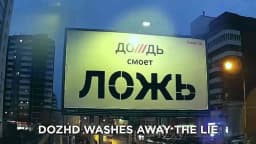
Rain vs. Lie - TV Rain | Clapboard Ad Archive
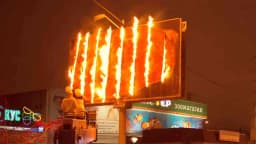
Rain vs. Lie for TV Rain, Russia’s only significant independent television news outlet, took the...
How Voskhod Made a Grandma the Face of Motive 4G in Russia
Motive's 'Grandma, Professor' is a 2014 Russian film campaign created by Yekaterinburg agency Voskhod, using two exaggerated character archetypes — a grandmother and a professor — to dramatise the speed of Motive's newly launched 4G internet service for a regional mobile operator competing against federal network brands.
Published in October 2014 in Russia, the campaign arrived at a commercially decisive moment for Motive. The brand operated as a regional challenger in the Ural telecommunications market, positioned against dominant federal operators through value-oriented and accessibly priced propositions. Launching 4G service represented a significant infrastructure step, and the creative task was equally significant: communicating raw technical capability — internet speed — without defaulting to the specification-heavy language that characterises much electronics and technology advertising. Voskhod's response was to discard technical framing entirely in favour of human comedy.
The campaign's central conceit places the concept of extreme speed inside two character types that Russian audiences immediately recognise — Baba Varya, a grandmother figure whose age implies the opposite of speed, and a professor whose cerebral authority implies the opposite of intuitive digital adoption. By routing the 4G speed argument through these personas, Voskhod created an inherent tension that the narrative resolves with humour and exaggeration. The two media assets comprising the campaign together built a character-driven universe rather than a single execution, giving the work breadth beyond a conventional thirty-second product demonstration. The Clapboard Score for this campaign is 66 out of 100, reflecting competent creative craft and a clear strategic idea that is effectively executed within the conventions of the category.
Motive entered the 4G conversation in Russia as a regional operator, not a federal one. According to budde.com.au, Russia recorded more than 241 million mobile subscriptions in 2014, representing penetration of approximately 170 percent of the population — a market already saturated at the subscription level, where growth had to come from service upgrades rather than new connections. Mobile data was the principal engine of that upgrade cycle: per veon.com, mobile internet use grew approximately 15 percent year over year by the end of 2014, and 3G and 4G adoption reached 23 percent of internet users, up from 17 percent a year earlier. These figures establish the competitive pressure Motive faced in persuading Ural-region subscribers to associate a regional brand with cutting-edge connectivity.
Voskhod's strategic answer was to avoid competing on network specification claims where federal rivals held obvious credibility advantages. According to Nag Ru, Motive had established itself as a challenger brand during the early 2010s, positioned against federal competitors including Tele2, through simplicity and aggressive pricing rather than through parity technology claims. 'Grandma, Professor' extends that logic into the 4G launch by making the speed argument emotional and comedic rather than technical and comparative. The grandmother figure — Baba Varya — functioned as a proxy for the audience's own scepticism: if 4G can transform even her relationship with internet speed, the implicit claim is that the technology is transformative rather than incremental. This kind of surrogate-consumer storytelling is a proven mechanism in telecommunications advertising, but Voskhod's execution applies it with enough local cultural specificity that the character registers as authentically Russian rather than generically relatable. Russia's mobile advertising market reached approximately 4.9 billion rubles in 2014, up from 3.1 billion rubles the prior year, according to Sostav Ru — a 59 percent increase that signals how aggressively operators of all sizes were investing in video-driven brand communication at precisely the moment this campaign launched.
Radioaktive Film produced the campaign, with direction credited to Marc R., as documented by luerzersarchive.com. Creative direction was led by Andrey Gubaydullin, with copywriting by Alexander Solodky and Egor Gavrilin, again per luerzersarchive.com. The production pipeline combined a character-comedy sensibility with the visual precision needed to make the speed metaphor legible on screen — a balance that determines whether this category of exaggerated narrative advertising reads as charming or merely chaotic.
The creative team's core decision was to cast the grandmother and professor not as victims of technology but as individuals who engage with 4G on their own terms. This distinction matters enormously in the execution. Advertising that positions older or non-technical characters as confused by digital products tends to generate mild condescension rather than genuine warmth. The 'Grandma, Professor' approach, as the campaign name signals, extends a kind of respectful absurdism to both figures: Baba Varya carries the comedic momentum through implied incongruity, while the professor's archetype provides an intellectual counterpoint that keeps the humour layered rather than one-dimensional.
The film format across two media assets allowed Voskhod to develop each character with enough screen time to build audience attachment rather than simply deploying them as visual shorthand. This structural choice is consistent with Voskhod's reputation in Russian advertising for preferring narrative depth over pure visual spectacle — a creative philosophy visible across the agency's body of work from its Yekaterinburg base. The 4G speed element is incorporated into the execution at the concept level rather than added as a graphic overlay or closing title card, which keeps the comedic logic intact throughout and avoids the tonal break that undermines many technology product films in the electronics category.
No verified performance data for the 'Grandma, Professor' campaign — including reach figures, conversion impact, or brand-tracking results — is publicly available. Analysis therefore rests on structural effectiveness and documented recognition.
The campaign received third place at the White Square Festival 2015 in category T12, Means and Services of Communication, subcategory T12-02-02, as recorded by En 2015 Adfest By. White Square is a significant creative competition across the Commonwealth of Independent States advertising community, and a podium finish in a telecommunications subcategory confirms that the work was evaluated as creatively distinguished within its market context. No verified entries or results for 'Grandma, Professor' at Cannes Lions, Effie Awards, The One Show, or D&AD are publicly documented, per clapboard.com.
Structurally, the campaign's effectiveness argument rests on three factors. First, the character-based narrative reduces the cognitive load of a technical product claim, making 4G speed intuitively comprehensible to the broadest possible regional audience. Second, the dual-asset format extends frequency and character depth simultaneously, which is an efficient use of a production budget for a regional operator without a federal media spend. Third, the culturally specific casting — anchored in the recognisable Russian archetype of Baba Varya — reduces the distance between the advertisement and its intended audience in a way that generic international creative templates cannot replicate. These structural properties, taken together, suggest a campaign that performed its core communicative function with economy and wit, even in the absence of documented commercial metrics.
'Grandma, Professor' is a 2014 Russian film campaign created by Voskhod for regional mobile operator Motive. It uses two character archetypes — a grandmother and a professor — to dramatise the speed of Motive's 4G internet service through humour and exaggeration rather than technical specification claims.
Voskhod, based in Yekaterinburg, Russia, created the campaign. Creative direction was led by Andrey Gubaydullin, with copywriting by Alexander Solodky and Egor Gavrilin, according to luerzersarchive.com. The film was produced by Radioaktive Film and directed by Marc R.
Baba Varya is the grandmother character at the centre of the Motive 'Grandma, Professor' campaign. She functions as a comedic surrogate for audience scepticism, with the implicit argument being that if 4G internet speed transforms her digital experience, the technology is genuinely powerful for any user.
The campaign received third place at the White Square Festival 2015 in category T12, Means and Services of Communication, as documented by en.2015.adfest.by. No verified results at Cannes Lions, Effie Awards, The One Show, or D&AD are publicly available, per clapboard.com.
Russia recorded more than 241 million mobile subscriptions in 2014, according to budde.com.au. Mobile internet use grew approximately 15 percent year over year by end of 2014, per veon.com. Motive operated as a regional challenger against federal operators, making a distinctive 4G brand narrative commercially essential.
The Clapboard Score for 'Grandma, Professor' is 66 out of 100. The score reflects competent creative craft and a clearly articulated strategic idea executed with cultural specificity, balanced against the inherent limitations of a regional campaign without documented reach or commercial performance metrics.
.webp)
Creative Collaboration Platform: The Backbone of Modern Creative WorkWhat is a creative collaboration platform?Clapboard defines a creative collaboration platform as the operational core for today’s distributed creative teams. This is not a collection of digital collaboration tools stitched together; Clapboard’s system


Understanding the Creative Production MarketplaceWhat is a Creative Production Marketplace?Clapboard defines a creative production marketplace as a structured ecosystem where brands, agencies, and production talent converge to execute video, advertising, and branded content at scale. Unlike the legacy agency or freelanREAD FULL ARTICLE

The Urgent Need for a Creative Production Operating SystemWhy Traditional Creative Production Models Break DownClapboard sees the creative production landscape shifting under pressure. Content velocity is no longer a buzzword—it’s a mandate. Modern advertising demands relentless output across dozens of channels, each wREAD FULL ARTICLE