OLW launched The Crunchometer in Sweden in October 2011, using an interactive ambient machine by JMW Kommunikation to transform the Crunchos corn snack

How OLW Made Sweden Stop and Crunch with The Crunchometer
The Crunchometer is an interactive ambient sampling machine created by JMW Kommunikation for OLW in Sweden in October 2011, designed to make consumers actively engage with the crunch of a new corn-based snack called Crunchos rather than passively accept a free sample and walk away.
OLW faced a problem familiar to every brand that has ever staffed a sampling table. Consumers at ordinary product-sampling events tend to accept the product, pocket it, and continue walking with little conscious attention paid to either the product or the brand. For the launch of OLW Crunchos — a corn snack positioned specifically around an intense crunch sensation — that passive dynamic was particularly damaging. A snack whose entire personality lives in a single audible, tactile moment cannot afford to be ignored at the precise moment it is being tasted for the first time.
JMW Kommunikation, the Stockholm-based agency behind the campaign, answered the brief with a single physical object: The Crunchometer. The machine invited participants to sample Crunchos in a structured, attentive way, transforming what would otherwise have been a forgettable giveaway into a deliberate sensory ritual. In Sweden, where the campaign ran in October 2011, the activation operated as a standalone ambient execution — one media asset, one mechanism, one product truth made physically undeniable. The Crunchometer earns a Clapboard Score of 63/100, reflecting strong conceptual clarity and efficient problem-solving against a limited production canvas.
OLW identified a structural failure at the heart of conventional sampling. The challenge was not consumer awareness of sampling as a format but consumer attention within it. Most sampling activations treat product trial as a quantity problem — distribute enough units and some percentage of recipients will remember the brand. For a corn snack like Crunchos, whose differentiating claim was extra crunch, volume-based sampling risked burying the very sensory detail the product needed to communicate.
OLW had established its broader cultural positioning in Sweden through the "Fredagsmys" platform, launched in 2009, which connected the brand to the Swedish social ritual of relaxed Friday-evening togetherness, according to Olw Se. That campaign encompassed television commercials, a branded song, and merchandise including branded leisurewear. The Crunchometer sat within that same strategic family — socialised, participatory snacking — but operated as a tactical, experiential extension rather than a replacement of the emotional platform, as noted by iwagency.com. Where Fredagsmys sold a feeling, The Crunchometer sold a fact: this snack is conspicuously loud when you bite it.
The Swedish snack market in 2011 sat within a broader European context where experiential and ambient formats were gaining traction as alternatives to interruptive media. Globally, the snack food sector was in growth, with 6wresearch.com reporting that the international savoury snacks segment was expanding steadily through this period. Competitors such as Estrella, the other dominant corn and potato snack brand in the Swedish market, and international entrants backed by Frito-Lay's distribution infrastructure, meant that shelf differentiation alone was insufficient for a new product entry. An event mechanic that physically encoded the product's core attribute gave Crunchos a story independent of shelf placement.
Creative Director Joakim Karlsson led the creative development of The Crunchometer at JMW Kommunikation, with Junior Creative Director and Designer Samuel Garlöv contributing to both the conceptual and visual execution, per Clapboard's records. Production was handled by Mässbolaget, a Swedish event and exhibition production company, whose involvement positioned the build as a trade and experiential asset rather than a conventional media placement.
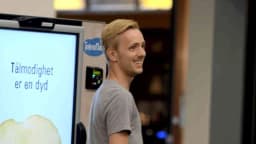
The Crunchometer functioned as a machine in the literal sense — a constructed object that participants interacted with to complete the sampling act. By giving the sampling event a mechanical frame, JMW transformed consumption into performance. The act of crunching, ordinarily private and momentary, became something measurable, something displayed. This inversion — from passive receipt to active participation — is the campaign's primary creative contribution. It did not change what Crunchos tasted like; it changed the context in which that taste was encountered, ensuring the crunch sensation registered consciously rather than dissolving into ambient noise.
As an ambient campaign, The Crunchometer produced a single documented media asset. This constraint is both a production reality and a creative statement. The campaign did not seek scale through replication but through intensity of encounter — a single well-designed object creating a disproportionate impression on the individuals who used it. The machine's visual and mechanical design served the communication directly: if the device itself communicated crunch through its aesthetic language, the product promise was reinforced before the first bite was taken. The choice of an ambient format over digital or broadcast channels reflects a deliberate alignment between medium and message — a physical product claim delivered through a physical object, in the physical Swedish market where Crunchos was seeking its initial foothold.
No verified performance data for The Crunchometer campaign is publicly available. No documented figures for sampling volumes, brand recall lift, post-event sales uplift for OLW Crunchos, or consumer engagement metrics have been published by OLW, JMW Kommunikation, or any independently verifiable source. The campaign's effectiveness must therefore be evaluated on structural grounds.
Structurally, The Crunchometer resolves its brief with uncommon directness. The stated challenge — that consumers pay little or no attention to products or brands during ordinary sampling events — is addressed not by adding more stimulus around the sample but by redesigning the sampling act itself. This is a solution that operates at the level of behaviour rather than communication, which is a more durable form of persuasion. A consumer who has consciously engaged with a machine to receive and taste Crunchos has had a categorically different experience from one who accepted a bag from a staffed table.
The campaign's single-asset, ambient format limits its reach by design. Its strength is depth of impression rather than breadth of exposure, making it most appropriately judged as a launch catalyst rather than a mass-awareness vehicle. Within that scope, the concept is well-matched to the product: a corn snack whose primary claim is sonic and tactile crunch, delivered through a device that frames crunch as an event worth measuring. The Crunchometer received a Clapboard Score of 63/100, reflecting strong conceptual economy and clear problem-solution alignment tempered by the inherent reach limitations of a single-location ambient activation with one documented media asset.
The Crunchometer was an ambient sampling activation created by JMW Kommunikation for OLW in Sweden in October 2011. It used a purpose-built interactive machine to encourage consumers to actively engage with the crunch of OLW Crunchos, a new corn-based snack, rather than passively accept a free sample at a conventional sampling event.
OLW was launching Crunchos, a corn-based snack positioned around an extra crunch sensation. The Crunchometer sampling event in Sweden in October 2011 was designed specifically to make consumers notice and remember that crunch at the moment of first trial, addressing the low-attention problem inherent in ordinary product-sampling events.
JMW Kommunikation, a Stockholm-based advertising agency, created The Crunchometer for OLW. Creative Director Joakim Karlsson and Junior Creative Director and Designer Samuel Garlöv led the creative work, with Swedish event production company Mässbolaget responsible for building the physical machine used at the sampling event.
The Crunchometer was a machine that invited consumers to sample OLW Crunchos in a structured, participatory way rather than simply accepting a product handout. By framing the act of eating the corn snack as an interactive, measurable experience, the activation ensured the snack's defining crunch sensation registered as a conscious, deliberate moment for each participant.
The Crunchometer received a Clapboard Score of 63/100. The score reflects the campaign's strong conceptual clarity and direct problem-solution alignment — redesigning the sampling act itself to hold consumer attention — balanced against the inherent reach limitations of a single-location ambient activation with one documented media asset.
The Crunchometer was a tactical extension of OLW's Fredagsmys brand platform, launched in 2009, which positioned OLW around sociable Swedish snacking rituals according to olw.se. Where Fredagsmys built emotional resonance through television and branded merchandise, The Crunchometer delivered a specific, sensory product truth for the Crunchos corn snack launch.
.webp)
Creative Collaboration Platform: The Backbone of Modern Creative WorkWhat is a creative collaboration platform?Clapboard defines a creative collaboration platform as the operational core for today’s distributed creative teams. This is not a collection of digital collaboration tools stitched together; Clapboard’s system


Understanding the Creative Production MarketplaceWhat is a Creative Production Marketplace?Clapboard defines a creative production marketplace as a structured ecosystem where brands, agencies, and production talent converge to execute video, advertising, and branded content at scale. Unlike the legacy agency or freelanREAD FULL ARTICLE

The Urgent Need for a Creative Production Operating SystemWhy Traditional Creative Production Models Break DownClapboard sees the creative production landscape shifting under pressure. Content velocity is no longer a buzzword—it’s a mandate. Modern advertising demands relentless output across dozens of channels, each wREAD FULL ARTICLE