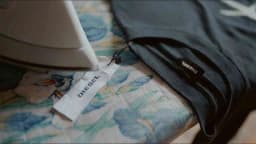
Paul Smith's 'A Suit to Travel In' campaign starred British Olympic gymnast Max Whitlock to demonstrate the crease-proof Merino wool travel suit's resilience

Paul Smith Sends Max Whitlock Tumbling Through a Travel Suit Campaign
Paul Smith's 'A Suit to Travel In' is a 2015 film campaign set in the United Kingdom in which British Olympic gymnast Max Whitlock performs demanding gymnastic movements while wearing a crease-proof Merino wool travel suit to demonstrate the garment's resilience and recovery properties in real physical conditions.
The campaign launched in September 2015, with its concept developed earlier that year for the London Collections: Men presentation showcasing the Paul Smith autumn/winter 2015 collection. The brief was precise: prove, through action rather than aesthetics, that a tailored suit could endure the stresses of modern travel without losing its shape. Paul Smith, founder and designer of the brand, stated the product's origins plainly: "What's so nice about the travel suit is that it's completely honest, because I'm on a plane every week of my life. It wasn't created for marketing hype, but because it's something that I personally needed, and it really does work." That statement of personal necessity anchors the entire campaign's credibility. The travel suit itself is constructed from high-twist, quick-recovery Merino wool with crease-resistant and water-repellent properties and contains no man-made fibres, making the material choice as deliberate as the casting. The campaign began as a United Kingdom presentation, expanded to a second event, then to a Japan event, and subsequently toured internationally, giving the film an audience that extended well beyond its British origins. The single film asset at the heart of the campaign accumulated more than 629,000 views, according to campaign records, establishing it as a significant piece of fashion content rather than a conventional product advertisement. The Clapboard Score for this campaign is 70 out of 100, reflecting strong creative concept and execution against the absence of publicly verified performance metrics.
Paul Smith identified a specific and underserved tension in British menswear: the professional man who travels constantly but refuses to surrender the standard of dress that defines his identity. The travel suit addresses that tension directly by engineering performance into traditional tailoring, and the campaign's strategic logic follows the same line. Rather than place the suit in an aspirational travel setting — a first-class cabin or a European capital — the brand chose to stress-test it against the most demanding physical demonstration available. Casting Max Whitlock, British Olympic medal-winning gymnast, as the campaign's lead talent translates the suit's technical properties into visible, undeniable proof. As Whitlock noted, "Paul contacted me out of the blue. He was looking for a gymnast to work with and the concept sounded really exciting." The choice is strategic rather than merely theatrical: gymnastics requires the full range of human movement, making it a credible and extreme proxy for the creasing, stretching, and compression that travel imposes on tailoring. In the United Kingdom during 2014 and 2015, suit demand was rising, supported by interest in better-fitting, relatively affordable tailoring and what observers described as a broader menswear renaissance, according to reporting by Complex. The premium menswear segment was growing faster than womenswear during the same period, according to the New York Times archive, giving Paul Smith a commercially receptive audience for a product that combined craft and function. The campaign did not position itself against a named competitor. Instead it staked territory within a competitive British menswear landscape by making material performance the primary argument, a move that differentiated the travel suit from conventionally marketed tailoring on a functional rather than purely stylistic basis.
The creative execution of 'A Suit to Travel In' is built around a single governing idea: let the suit speak through movement. On screen, Max Whitlock performs a sequence of demanding gymnastic routines — including tumbles, flips, and full-extension movements — entirely dressed in the Paul Smith travel suit. The camera captures each movement at close range, allowing the fabric's recovery and crease resistance to register visibly between and after each physical sequence. The result is a product demonstration film in which the product's function is the drama, with no narration required to explain what the viewer is watching. Creative direction came from Alan Aboud and the Aboud Sodano creative practice, whose history with Paul Smith spans long-form visual storytelling rooted in the brand's particular blend of British wit and craft rigour. Movement direction drew on performers associated with the Royal Shakespeare Company and the National Centre for Circus Arts, a collaboration that brought theatrical precision to what could otherwise have been a straightforward sports demonstration. That combination of fashion creative direction and performance arts expertise gives the film an aesthetic register that sits between editorial fashion and live event documentation. The Merino wool construction of the suit — high-twist, quick-recovery, water-repellent, and free of synthetic fibres, as documented by Woolmark — becomes legible on screen precisely because Whitlock's movements are so extreme. Production credits beyond Alan Aboud and the named movement collaborators are not fully detailed in available public sources. The campaign format is classified as a product demonstration film, but its execution operates closer to performance art, a distinction that explains both its creative ambition and its durability as an archival piece.
No independently verified performance data for 'A Suit to Travel In' is publicly available beyond the campaign's documented view count. Campaign records indicate the film accumulated more than 629,000 views, according to paulsmith.com and associated archive records, a figure that reflects meaningful organic reach for a brand-led fashion film in 2015, before short-form video dominated the category. The campaign's structural effectiveness, however, can be assessed on its own terms. The decision to open the campaign at London Collections: Men gave it immediate trade and press visibility within the United Kingdom's most concentrated menswear audience. The subsequent expansion to events in Japan and further international touring extended that reach without requiring additional media spend on traditional advertising. The September 2015 Indian market launch, which priced travel suit jackets from INR 60,000 and trousers from INR 20,000 according to IDiva, confirms that the campaign supported a live commercial rollout across multiple geographies rather than functioning purely as brand content. The choice of a demonstration format — with no reliance on narrative voiceover, celebrity lifestyle association, or aspirational setting — means the film ages well and retains its argument across repeated viewings and new audiences. The Clapboard Score of 70 out of 100 reflects that balance: a campaign with genuine creative distinction and a clear, testable product claim, held back only by the absence of independently published performance outcomes.
'A Suit to Travel In' is a 2015 Paul Smith film campaign set in the United Kingdom. It features British Olympic gymnast Max Whitlock performing gymnastic routines in a crease-proof Merino wool travel suit, demonstrating the garment's resilience, flexibility, and quick-recovery properties through extreme physical movement rather than conventional fashion imagery.
Paul Smith cast Max Whitlock because gymnastics demands the full range of human movement, making it a credible stress test for a crease-resistant suit. Whitlock's extreme routines made the suit's technical properties — high-twist Merino wool, water repellence, and quick recovery — visibly demonstrable on screen in a way no static image could achieve.
The Paul Smith travel suit is constructed from high-twist, quick-recovery Merino wool with crease-resistant and water-repellent properties, as documented by Woolmark. The fabric contains no man-made fibres, making the performance qualities entirely dependent on the natural characteristics of the Merino wool and its specialist high-twist construction.
Creative direction for 'A Suit to Travel In' came from Alan Aboud and the Aboud Sodano creative practice. Movement direction involved performers associated with the Royal Shakespeare Company and the National Centre for Circus Arts, bringing theatrical and circus performance precision to the film's gymnastic demonstration sequences.
The campaign concept was developed in January 2015 for the London Collections: Men presentation and launched publicly in September 2015 in the United Kingdom. It subsequently expanded to events in Japan and toured internationally, with the Indian market launch also occurring in September 2015, pricing suit jackets from INR 60,000 according to IDiva.
The Clapboard Score for 'A Suit to Travel In' is 70 out of 100. The score reflects the campaign's strong creative concept and distinctive execution — particularly its demonstration format and performance arts collaboration — balanced against the absence of independently published audience or commercial performance data for the 2015 United Kingdom campaign.
.webp)
Creative Collaboration Platform: The Backbone of Modern Creative WorkWhat is a creative collaboration platform?Clapboard defines a creative collaboration platform as the operational core for today’s distributed creative teams. This is not a collection of digital collaboration tools stitched together; Clapboard’s system


Understanding the Creative Production MarketplaceWhat is a Creative Production Marketplace?Clapboard defines a creative production marketplace as a structured ecosystem where brands, agencies, and production talent converge to execute video, advertising, and branded content at scale. Unlike the legacy agency or freelanREAD FULL ARTICLE

The Urgent Need for a Creative Production Operating SystemWhy Traditional Creative Production Models Break DownClapboard sees the creative production landscape shifting under pressure. Content velocity is no longer a buzzword—it’s a mandate. Modern advertising demands relentless output across dozens of channels, each wREAD FULL ARTICLE