Perrier Turns Shanghai Metro Into a Jungle for PerrierXWild
Perrier converted South Huangpi Road Metro station in Shanghai into a fully immersive jungle environment in October 2017, working with agency Havas and media partner STDecaux to launch the PerrierXWild limited edition in China.
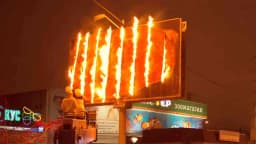
The activation centred on the PerrierXWild collection, a limited edition designed by artist Juan Travieso and comprising six bottles and five lifestyle objects, each displayed within the station itself. The creative concept was straightforward in its ambition: introduce the vocabulary of the wild into one of the most densely trafficked urban transit spaces in China. Station pillars were wrapped and sculpted to resemble giant trees, complete with artificial treetops extending toward the ceiling. As passengers moved through the concourse, the trees responded — lighting up progressively from the roots upward — while integrated speakers delivered the sound of a lion's roar at the moment of activation. The result was an installation that turned a routine commute into an unexpected sensory encounter.
In the Chinese market, where premium imported sparkling water occupies a prestige niche distinct from domestic bottled-water brands, the choice of the Shanghai Metro as a media environment was deliberate. South Huangpi Road station sits in the heart of one of the city's most commercially active districts, ensuring the activation reached an affluent, cosmopolitan audience precisely aligned with PerrierXWild's positioning. The campaign ran for one month, according to available documentation, and was classified as an outdoor campaign within the non-alcoholic drinks category. Clapboard scores this campaign 74 out of 100, reflecting strong creative distinctiveness and effective use of experiential media within a competitive luxury-drinks landscape.
Perrier operates within a premium sparkling-water segment that demands consistent brand differentiation to justify its price positioning against competitors. In 2017, the global premium bottled-water market was valued at US$16.5 billion, growing at an annual rate of approximately 8.1%, according to Zenith Marketing Intelligence. Within that context, Perrier and rival San Pellegrino each held an estimated five to ten percent of premium sparkling-water value globally, according to available market analysis, making distinction at the point of cultural encounter essential rather than optional.
In China specifically, the imported premium water category was expanding alongside a broader premiumisation trend in consumer goods. The Shanghai Metro system — one of the busiest rapid-transit networks in the world — offered Perrier and Havas a media environment that combined sheer audience scale with a captive, dwell-time-rich context rarely available in above-the-line formats. STDecaux, the out-of-home media partner on this activation, operates across major Chinese transit networks and provided the infrastructure necessary to execute sensor-triggered lighting and audio at station level.
The PerrierXWild concept — positioning the brand's natural carbonation and source-water credentials through the lens of untamed wilderness — responded directly to a growing consumer appetite in China for authenticity and experiential storytelling from imported lifestyle brands. By situating Juan Travieso's wild aesthetic inside an intensely urban environment, Havas constructed a tension that is itself the brand argument: Perrier belongs wherever sophistication and nature collide, even underground in Shanghai. The campaign's one-month duration, as documented across available records, gave the installation sufficient time to generate organic social amplification among Shanghai's digitally active commuter population.
Juan Travieso designed the PerrierXWild limited edition that anchored the Shanghai Metro activation. Travieso, whose practice engages with wildlife and natural imagery translated into graphic and product design, supplied the visual language — vivid, illustrative representations of wild animals and botanical forms — that migrated from bottle label to architectural installation. The campaign transferred his aesthetic at a scale that turned infrastructure into scenography.
The physical execution was managed in partnership with STDecaux. Station pillars, typically inert structural elements, were entirely reimagined as giant trees. Artificial foliage was constructed to extend from pillar capitals, creating a canopy effect within the station concourse. The scale of this transformation was not incidental; it was the primary creative mechanism, designed to generate a moment of genuine visual disruption for passengers whose expectations of that space were entirely fixed. Motion-sensing technology embedded in the installation tracked passenger movement and triggered a progressive lighting sequence that travelled from the root of each tree upward, animating the structure in direct response to human presence. Simultaneously, speakers broadcast the sound of a lion's roar — a sonic cue tied directly to the wild-animal imagery of the PerrierXWild collection.
The six limited-edition bottles and five lifestyle objects from the PerrierXWild range were displayed within the station, connecting the experiential environment to a tangible commercial object. Production credits beyond Juan Travieso's design role and STDecaux's media and installation partnership are not publicly documented for this campaign. Havas Shanghai served as the lead creative agency. The integration of motion response, spatial transformation, and product display within a single transit environment represents a layered creative execution that extends well beyond conventional out-of-home poster placement.
No independently verified commercial performance data for the Perrier Shanghai Metro jungle activation — such as sales uplift for the PerrierXWild limited edition or measurable brand-awareness shifts in the Chinese market — is publicly available. The campaign documentation archived on Clapboard records 10,952 views and 50 likes against the campaign listing, figures that reflect archival engagement within the advertising industry rather than consumer reach metrics.
Structurally, however, the campaign demonstrates several characteristics associated with high-performing experiential out-of-home work. The motion-triggered lighting and lion-roar audio created a participatory mechanic that transformed passive pedestrian traffic into active brand encounters — a dynamic that consistently drives organic social sharing in transit environments, particularly in a market like China where platforms such as WeChat and Weibo accelerate the spread of visually striking content. The one-month installation window, as documented across campaign records, provided sufficient dwell time for iterative audience exposure and word-of-mouth generation within Shanghai's commuter population.
The decision to display the physical PerrierXWild collection — six bottles and five lifestyle objects — within the station closed the loop between experiential impression and product consideration, an integration that many purely atmospheric installations fail to achieve. Perrier's history of artist-led limited editions, extending from Salvador Dalí's work in 1969 and Andy Warhol's forty-plus bottle artworks in 1983, as documented by Brand Memory and Design Boom respectively, establishes a lineage that lends cultural credibility to activations of this kind. Within that canon, the PerrierXWild Shanghai activation holds a coherent and strategically logical position. Clapboard scores the campaign 74 out of 100.
Perrier transformed South Huangpi Road Metro station in Shanghai into an immersive jungle environment in October 2017. Created by Havas with media partner STDecaux, the activation launched the PerrierXWild limited edition designed by artist Juan Travieso, featuring motion-triggered tree lighting, lion-roar audio, and displayed collector objects throughout the station.
Juan Travieso designed the PerrierXWild limited edition. Travieso's work, rooted in wildlife and natural imagery, provided the visual language for both the product — six bottles and five lifestyle objects — and the large-scale jungle installation built inside Shanghai's South Huangpi Road Metro station by Havas and STDecaux in 2017.
Motion sensors tracked passengers moving through South Huangpi Road station. As commuters passed, station pillars styled as giant trees lit up progressively from the roots upward, while integrated speakers simultaneously broadcast a lion's roar. The system created a live, responsive encounter rather than a static display, connecting directly to PerrierXWild's wild-nature proposition.
Havas served as the lead creative agency for the Perrier Shanghai Metro jungle campaign. STDecaux acted as the out-of-home media and installation partner, providing access to the South Huangpi Road Metro station environment and the infrastructure needed to execute sensor-triggered lighting and audio. The campaign ran in China in October 2017.
South Huangpi Road Metro station sits within one of Shanghai's most commercially active districts, delivering concentrated access to an affluent urban audience aligned with PerrierXWild's premium positioning. The transit environment offered captive dwell time unavailable in standard outdoor formats, while China's premiumisation trend made Shanghai a strategically appropriate market for the launch.
Clapboard scores the Perrier PerrierXWild Shanghai Metro jungle campaign 74 out of 100. The score reflects strong creative distinctiveness through its immersive, motion-responsive jungle environment and effective integration of product display within the experiential space, balanced against the absence of publicly verified consumer performance metrics for the Chinese market activation.
.webp)
Creative Collaboration Platform: The Backbone of Modern Creative WorkWhat is a creative collaboration platform?Clapboard defines a creative collaboration platform as the operational core for today’s distributed creative teams. This is not a collection of digital collaboration tools stitched together; Clapboard’s system


Understanding the Creative Production MarketplaceWhat is a Creative Production Marketplace?Clapboard defines a creative production marketplace as a structured ecosystem where brands, agencies, and production talent converge to execute video, advertising, and branded content at scale. Unlike the legacy agency or freelanREAD FULL ARTICLE

The Urgent Need for a Creative Production Operating SystemWhy Traditional Creative Production Models Break DownClapboard sees the creative production landscape shifting under pressure. Content velocity is no longer a buzzword—it’s a mandate. Modern advertising demands relentless output across dozens of channels, each wREAD FULL ARTICLE