Secretaria de Saúde de Pernambuco Reframes Blood Donation in 360 Degrees
The 360º Blood Poster is an outdoor public interest campaign created by Blackninja for Secretaria de Saúde de Pernambuco, published in Brazil in August 2012, using an immersive 360-degree poster format to encourage blood donation as a civic and life-saving act.
Secretaria de Saúde de Pernambuco, the health secretariat of one of Brazil's most populous northeastern states, commissioned the campaign to address a persistent challenge in public health communication: motivating voluntary blood donation among the general population. Rather than relying on conventional instructional messaging, the campaign took its case directly to the street through out-of-home advertising — a medium with an unmediated presence in everyday public life across Brazilian cities. The single media asset at the centre of the campaign was designed to be encountered in physical space, demanding attention through its format rather than through volume of spend.
The campaign sits within a tradition of Brazilian public interest advertising that uses creative ingenuity to compensate for modest production resources. In Brazil, government health bodies have historically operated within tightly defined communications budgets. The 360º Blood Poster earned its impact not through saturation but through the inventiveness of its execution, presenting blood donation not as an obligation but as an idea worth stopping for. The Clapboard Score for this campaign is 71 out of 100, reflecting genuine creative ambition within the structural constraints of a public-sector health brief.
Secretaria de Saúde de Pernambuco selected out-of-home advertising as the primary medium for this campaign. That choice reflects a clear-eyed reading of how public health messages reach audiences in Brazil's urban northeast, where street-level media occupies a prominent role in daily life and can reach citizens across income groups without requiring a screen or a subscription.
Blood donation campaigns face a specific communication problem: the act of donating is painless, free, and widely understood to save lives, yet voluntary donation rates remain a persistent concern for health systems worldwide. In Brazil, public-sector communications have historically leaned heavily on broadcast media. According to Gov Br, Brazil's Ministry of Transport allocated R$5.24 million to television and R$649,601.75 to radio for media placements in 2012 alone, illustrating how dominant broadcast spending was across government communications at the time. Against that backdrop, an OOH execution for a state health body represented a deliberate departure — choosing presence and craft over reach and frequency.
The campaign also reflects the communications history of Secretaria de Saúde de Pernambuco, which, according to Portal Saude Pe Gov Br, won the Cristina Tavares Press Award in 2008 — described as historically unusual recognition for a public-sector body. That precedent suggests an institution with a genuine investment in communications quality, not merely compliance with messaging mandates. By entrusting the brief to Blackninja, a Recife-based agency embedded in the same northeastern Brazilian market the campaign sought to reach, the secretariat ensured that the creative response would be locally grounded.
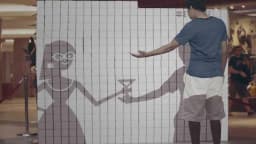
The 360º Blood Poster is built around a single, formally inventive poster designed to be experienced in the round. The campaign's core creative conceit is structural: the poster uses a 360-degree format to envelop the viewer's field of vision, transforming what would ordinarily be a flat, frontal piece of outdoor advertising into an immersive encounter. The effect places the audience inside the message rather than in front of it, making the act of looking at the poster an embodied experience that mirrors the total, surrounding importance of blood donation to human life.
The on-screen execution, as documented in available sources, presents the poster as a physical installation within public space, using its circular geometry to command the surrounding environment. The format itself becomes the argument: a 360-degree design communicates totality, urgency, and inclusion without requiring additional copy to carry that weight. The single documented media asset is the poster itself, and its impact is inseparable from the decision to let format do the rhetorical work.
The creative team responsible for the campaign is credited as follows: Creative Director Lenilson Lima, Art Director Bertone Balduino, and Copywriter Ian Thomé led the conceptual and executional work. Account direction was handled by Maria Edith. The campaign was produced by VDG, with direction and director of photography credit going to Renata Oliveira, and photography by Thiago Freire. The depth of that production roster — encompassing both a director of photography and a dedicated photographer — signals that the physical construction and documentation of the poster were treated with the same seriousness as the concept itself. For a public interest campaign operating within state health secretariat constraints, that level of craft investment is notable.
No verified performance data for the 360º Blood Poster is publicly available. No independently documented business results, donation-rate figures, or audience reach metrics have been published in connection with this campaign, and no awards or finalist placements are on record for it, as confirmed across available sources including linkedin.com and Comunicaquemuda Com Br.
Structural analysis, however, offers a reasonable basis for assessing the campaign's likely effectiveness within its context. The choice of out-of-home advertising for a blood donation message in Brazil in 2012 was strategically coherent: OOH reaches citizens in shared public space, removes the skip-and-scroll behaviours that diminish digital media impact, and delivers a message at full scale to a broad cross-section of urban society. The 360-degree format amplified this inherent advantage by creating a physically distinctive installation that would naturally attract dwell time and generate word-of-mouth in an era before social amplification of OOH executions was a standard planning consideration.
The campaign's greatest structural asset is its insistence on form as meaning. By designing a poster that surrounds rather than confronts, Blackninja reframed a transactional health appeal — give blood — as an experiential proposition. For a public interest brief with a single media asset and no documented paid amplification, that conceptual efficiency is a meaningful indicator of creative quality. The Clapboard Score of 71 out of 100 reflects that assessment: a campaign that earns its place in Brazil's public interest advertising history through inventiveness rather than scale.
The 360º Blood Poster is a public interest OOH campaign created by Blackninja for Secretaria de Saúde de Pernambuco in Brazil in August 2012. It uses an immersive, 360-degree poster format to encourage blood donation, treating its circular structure as the primary persuasive device rather than conventional headline-driven messaging.
Blackninja, a Recife-based agency, created the campaign. Creative Director Lenilson Lima, Art Director Bertone Balduino, and Copywriter Ian Thomé led the work. Production company VDG executed it, with Renata Oliveira directing and handling cinematography, and Thiago Freire credited as photographer. Account direction was managed by Maria Edith.
Secretaria de Saúde de Pernambuco chose OOH to reach broad urban audiences in a shared public setting, without relying on broadcast budgets. Out-of-home advertising in Brazil delivers messages across income groups at street level, and the 360-degree format created a physically distinctive presence that generated attention without paid amplification.
No awards or finalist placements are on record for the 360º Blood Poster. Despite the campaign's creative ambition and inventive use of the OOH format, no documented recognition from industry award programmes has been confirmed in available sources, including those covering Brazilian public interest advertising from 2012.
The 360º Blood Poster holds a Clapboard Score of 71 out of 100. That score reflects genuine creative ambition — particularly the decision to use a 360-degree format as a rhetorical device — balanced against the absence of verified performance data and the campaign's single-asset, state-budget constraints within the Brazilian public health sector.
The campaign represents a strand of Brazilian public interest advertising that prioritises conceptual invention over media scale. Secretaria de Saúde de Pernambuco has a documented history of communications ambition, having won the Cristina Tavares Press Award in 2008 according to portal.saude.pe.gov.br, making the 360º Blood Poster consistent with the institution's creative communications heritage.
.webp)
Creative Collaboration Platform: The Backbone of Modern Creative WorkWhat is a creative collaboration platform?Clapboard defines a creative collaboration platform as the operational core for today’s distributed creative teams. This is not a collection of digital collaboration tools stitched together; Clapboard’s system


Understanding the Creative Production MarketplaceWhat is a Creative Production Marketplace?Clapboard defines a creative production marketplace as a structured ecosystem where brands, agencies, and production talent converge to execute video, advertising, and branded content at scale. Unlike the legacy agency or freelanREAD FULL ARTICLE

The Urgent Need for a Creative Production Operating SystemWhy Traditional Creative Production Models Break DownClapboard sees the creative production landscape shifting under pressure. Content velocity is no longer a buzzword—it’s a mandate. Modern advertising demands relentless output across dozens of channels, each wREAD FULL ARTICLE