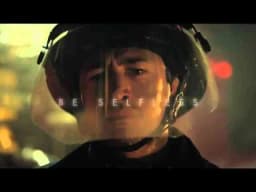
Tungsten's 2016 Happy Holidays campaign used a Cornell University computer-vision algorithm run in reverse to generate abstract holiday imagery from the

Tungsten Turns AI Hallucination Into Holiday Art in 2016
Blog Chinatungsten.clapboard.com/archive/ledvance-happy-holidays-electronics-2">Tungsten's "Happy Holidays" campaign is a self-promotional digital work released in the United States in December 2016, in which the San Francisco agency trained a computer-vision algorithm to recognise its own logo and then ran that algorithm in reverse against images of trees and snowflakes, producing an abstract, hallucinatory visual experience that the agency positioned as an entirely new art form, according to Happytreefanon Fandom.
The campaign operates outside the conventions of client-facing advertising, according to Commarts. Tungsten built the project as an internal demonstration of creative and technical ambition, releasing it at year's end as both a seasonal greeting and a statement of intent about the agency's relationship with emerging technology, according to LinkedIn. Its subject is artificial intelligence itself — specifically, what happens when a machine learning system is asked to perform a task it was not designed to complete. The result is a single digital media asset that is equal parts technical experiment and aesthetic provocation.
In the United States in 2016, conversations about AI and machine creativity were accelerating rapidly across the media and entertainment industries, making Tungsten's decision to build a holiday message around computational neural networks both timely and strategically sharp. The campaign carries a Clapboard Score of 72 out of 100, reflecting its originality of concept and the coherence between its medium and its message. The geographic market is unambiguously domestic: Tungsten is a San Francisco agency speaking, in the first instance, to a United States audience of clients, collaborators, and peers within the advertising and creative industries, according to Chiefmarketer.
Tungsten made a deliberate choice to use its own holiday greeting as a proof of concept for machine learning. Rather than producing a conventional seasonal card or a visually polished but conceptually safe piece of motion design, the agency elected to let an algorithm author the work, intervening only at the level of setup and framing. This decision signals a strategic position: that understanding emerging technology from the inside is a prerequisite for deploying it on behalf of clients.
The timing matters. In the United States in 2016, programmatic video spending reached a significant threshold, with digital moving decisively toward data-driven and algorithmically mediated formats. According to the Interactive Advertising Bureau, the broader shift toward automated and intelligent advertising systems was reshaping how agencies in the US market justified their creative and technical value. Against that backdrop, Tungsten's choice to demonstrate hands-on fluency with computer vision and neural networks was not merely aesthetic — it was a competitive positioning move directed at current and prospective clients in the American market.
The strategic rationale, as the agency articulated it, looked explicitly toward 2017 and beyond, framing the campaign as a meditation on how newer technologies continue to transform the advertising business and how Tungsten intended to adapt and use them commercially for client benefit. That forward-facing framing transforms a holiday greeting into a capabilities statement. The competitive landscape for creative technology agencies in the United States at this moment was expanding rapidly, with VFX-literate and digitally native shops raising the bar for what self-promotional work was expected to demonstrate.
Tungsten developed the "Happy Holidays" campaign by taking a computer-vision and pattern-recognition algorithm originally developed at Cornell University and training it to identify the agency's own logo using machine learning techniques grounded in computational neural networks. The creative team then ran the trained algorithm in reverse while feeding it images of trees and snowflakes — inputs the system had no framework to interpret through the lens of its logo-recognition task.
On screen, the result is a trippy, mesmerising visual sequence in which the algorithm, unable to find the logo it was trained to detect, begins hallucinating it into existence. The machine imposes logo-like forms onto organic holiday imagery — snowflakes distort, tree shapes warp — generating an abstract, shifting visual field that hovers between recognisable symbol and pure pattern noise. The effect is generative and unrepeatable in the way that analogue processes once were, except that here the chaos is computational rather than chemical.
Creative director Chip Garner and art director Christopher Stanley are credited on the campaign. Their role was not to design the imagery directly but to design the conditions under which the algorithm would produce imagery — a form of creative direction that is itself a commentary on authorship in an era of machine learning. The agency is explicit that the aesthetic outcome could not have been fully predicted or controlled, which is precisely what gives the work its conceptual integrity. Production credits beyond Garner and Stanley are not publicly documented. The piece exists as a single digital asset, and its craft lies in the architecture of the experiment rather than in post-production finish.
No verified performance data for the "Happy Holidays" campaign is publicly available. Tungsten produced the work as an internal agency self-promotion rather than a client campaign with contracted deliverables or tracked media spend, and no reach, engagement, or conversion figures have been published in the United States advertising trade press or attributed to any named source.
What can be assessed is the structural effectiveness of the campaign's approach. As a piece of agency self-promotion, its primary function is reputational: to demonstrate technical fluency and creative risk-taking to a professional audience of clients and industry peers in the US market. On those terms, the work is coherent. The concept is inseparable from its execution — an algorithm that hallucinates logos is both the subject of the campaign and the means by which the campaign was made. That unity of idea and form is rare in self-promotional work, which frequently describes capability rather than embodying it.
Communication Arts, one of the United States' most respected creative industry publications, is among the platforms that have documented the campaign, lending it a degree of curatorial endorsement within the American advertising and design community. The campaign's Clapboard Score of 72 out of 100 reflects recognition of its originality and conceptual clarity, balanced against the inherent limitations of a single-asset digital release with no measurable audience outcomes on record.
Tungsten's "Happy Holidays" is a 2016 digital self-promotion released in the United States. The San Francisco agency trained a Cornell University computer-vision algorithm to recognise its logo, then ran it backwards through images of trees and snowflakes, generating abstract hallucinatory visuals the agency described as an entirely new art form.
Tungsten trained a machine learning algorithm, built on computational neural networks and developed at Cornell University, to identify the agency's logo. Running that algorithm in reverse while showing it holiday imagery caused it to hallucinate logo forms into snowflakes and trees, producing the campaign's distinctive abstract visual effect.
Chip Garner served as creative director and Christopher Stanley as art director on the "Happy Holidays" campaign. Their creative direction involved designing the conditions of the algorithm experiment rather than authoring the imagery directly, making the act of system design itself the primary creative decision.
Tungsten used the campaign to demonstrate hands-on fluency with machine learning at a moment when AI was reshaping the United States advertising industry. The agency framed the work as a forward-looking statement about how it intended to use emerging technologies commercially for clients in 2017 and beyond.
The Tungsten "Happy Holidays" campaign holds a Clapboard Score of 72 out of 100. The score reflects the campaign's strong originality of concept and the tight alignment between its medium and message, balanced against its single-asset scope and the absence of publicly documented audience performance metrics.
.webp)
Creative Collaboration Platform: The Backbone of Modern Creative WorkWhat is a creative collaboration platform?Clapboard defines a creative collaboration platform as the operational core for today’s distributed creative teams. This is not a collection of digital collaboration tools stitched together; Clapboard’s system


Understanding the Creative Production MarketplaceWhat is a Creative Production Marketplace?Clapboard defines a creative production marketplace as a structured ecosystem where brands, agencies, and production talent converge to execute video, advertising, and branded content at scale. Unlike the legacy agency or freelanREAD FULL ARTICLE

The Urgent Need for a Creative Production Operating SystemWhy Traditional Creative Production Models Break DownClapboard sees the creative production landscape shifting under pressure. Content velocity is no longer a buzzword—it’s a mandate. Modern advertising demands relentless output across dozens of channels, each wREAD FULL ARTICLE