znak.com's 2013 Extremist Constitution outdoor campaign by Red Pepper quoted the Russian Constitution verbatim — and was refused by billboard operators who

znak.com Turns Russia's Own Constitution Into an Outdoor Provocation
The Extremist Constitution is a 2013 OOH outdoor campaign created by Red Pepper for znak.com, a Yekaterinburg-based Russian news web portal, in which verbatim quotations from the Constitution of the Russian Federation were placed on outdoor banners — only for billboard operators across Russia to refuse to display several of them on the grounds that constitutional text sounded extremist.
Launched in early 2013 and archived with an April 2013 date, the campaign arrived at a symbolically charged moment: around the 20th anniversary of the Russian Constitution's adoption. znak.com, founded by journalist Aksana Panova on December 3, 2012, was barely four months old when Red Pepper conceived this single-asset outdoor execution. The campaign's subject matter was not invented commentary or editorial opinion — every word on every banner was drawn directly from constitutional guarantees enshrined in Russian law, including articles affirming equality before the law and the freedom of thought and speech.
In Russia, the campaign immediately provoked a reaction that became its own editorial story. Advertising-space companies declined to carry certain banners, arguing that the constitutional quotations read as a challenge to authority. That refusal transformed the outdoor campaign into a press freedom narrative, one that travelled far beyond Yekaterinburg and established znak.com as a media outlet willing to use the tools of commercial advertising to surface civic discomfort. The campaign contains one media asset and sits at the intersection of outdoor advertising craft, media industry commentary, and political narrative — earning a Clapboard Score of 70 out of 100.
znak.com entered the Russian media industry at a moment of heightened tension around press freedom. The site launched in December 2012 and Red Pepper developed the Extremist Constitution campaign within its first four months of operation, a timeline that speaks to the urgency behind the brief. The strategic logic was precise: rather than advertising the platform's journalism directly, the campaign would use constitutional text — the supreme law of the land — to demonstrate the gap between Russia's written guarantees and their practical application.
The choice of outdoor advertising as the medium was deliberate. OOH placements in Russian cities carry an implicit expectation of neutrality; they sell products, not politics. By submitting constitutional quotations to that same commercial infrastructure, Red Pepper forced billboard operators into an impossible position. When those operators refused to display the banners, citing the articles' apparent challenge to authority, they proved the campaign's argument without znak.com having to make it. As reported by The New East Archive, Dmitry Kolezev, deputy editor-in-chief of znak.com, observed that many people felt the constitutional quotations sounded extremist — a reaction that validated the entire strategic premise.
The Russian media environment in 2013 was competitive and increasingly constrained, with regional digital news outlets like znak.com operating in a landscape shaped by significant editorial pressure. The campaign distinguished the platform from generic news aggregators by positioning it as a source of civic courage, using the entertainment and persuasion mechanics of outdoor advertising to deliver a message no conventional editorial could land with the same force. The strategy did not require a large media buy — it required the right refusal.
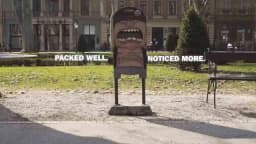
Red Pepper built the Extremist Constitution campaign around a single, uncompromising creative decision: the copy would be the Constitution of the Russian Federation, presented verbatim and without editorial framing. The banners quoted specific constitutional articles guaranteeing equality before the law and freedom of thought and speech — foundational civic promises rendered in the visual language of commercial outdoor advertising.
On the face of the billboards, viewers encountered text drawn directly from Russia's governing document, set in the clean, authoritative typographic register of a civic announcement. No illustration, no brand rhetoric, no explanatory subheading softened the encounter. The constitution spoke for itself, and that austerity was the execution. The single media asset that comprises the campaign demonstrates a disciplined restraint: the creative team understood that embellishment would dilute the provocation and that the words, standing alone, carried more rhetorical weight than any visual device could add.
The campaign was directed by creative directors Danil Golovanov and Nikita Harisov, with art direction by Irina Korotich and Natasha Kotovskaya. Dmitry Kolezev, deputy editor-in-chief of znak.com, also received a production credit, reflecting the editorial collaboration between client and agency that shaped the campaign's unusually document-led creative approach. As reported by The New East Archive, Kolezev noted in a France 24 interview conducted in early 2013 that readers responded to the constitutional quotations with the same instinctive unease the team had felt when first selecting them — a confirmation that the creative instinct had been calibrated correctly. Per adruby.com and Sostav Ru, the campaign's creative team at Red Pepper, Yekaterinburg, produced the work with the economy of means that outdoor advertising demands: one idea, one surface, one law.
 ARCHIVE
No verified performance data for the Extremist Constitution campaign — such as reach figures, earned media impressions, or audience growth metrics for znak.com — is publicly available. What is documented, however, constitutes a form of impact more legible than click-through rates.
As reported by The New East Archive, advertising-space operators in Russia refused to carry several of the banners, stating that the constitutional quotations sounded extremist. That institutional refusal was itself a media event. The story of a news outlet being denied outdoor space for quoting its own country's constitution generated coverage that extended the campaign's reach far beyond any planned media buy. The New East Archive documented the campaign and Kolezev's account of public response in an article published October 2, 2013, and the story was subsequently cited in coverage connected to press freedom discussions, per new-east-archive.org.
Structurally, the campaign demonstrates the effectiveness of a strategy in which the anticipated resistance of gatekeepers becomes the primary distribution mechanism. The billboard operators' refusal was not a failure of the outdoor campaign — it was its proof of concept, delivering the narrative about press freedom and civic rights that znak.com had set out to surface. For a media outlet less than four months old operating in Russia's constrained regional media environment, the campaign functioned as a credibility-building exercise whose editorial value significantly exceeded its production cost. The Extremist Constitution stands as a durable example of how a single outdoor asset, refused rather than displayed, can generate a more enduring narrative than conventional placement ever could.
The Extremist Constitution was a 2013 outdoor advertising campaign created by Red Pepper for znak.com, a Yekaterinburg-based Russian news portal. It placed verbatim quotations from the Constitution of the Russian Federation on outdoor banners, prompting billboard operators to refuse display on the grounds that constitutional text sounded extremist to authorities.
Billboard operators refused the banners because the constitutional quotations felt like a challenge to Russian authorities. As reported by The New East Archive, Dmitry Kolezev of znak.com noted that readers and operators alike felt the constitutional text — guaranteeing rights such as equality and freedom of speech — sounded extremist in Russia's 2013 media environment.
Red Pepper, an advertising agency based in Yekaterinburg, Russia, created the campaign. Creative directors Danil Golovanov and Nikita Harisov led the work, with art direction by Irina Korotich and Natasha Kotovskaya. Dmitry Kolezev, deputy editor-in-chief of znak.com, also received a production credit reflecting the client's editorial involvement.
The campaign launched in early 2013, with February 2013 cited as the release date, coinciding with the 20th anniversary of the Russian Constitution's adoption. Archive records also reference April 2013. znak.com itself had been founded only in December 2012, making this campaign one of its earliest major public statements as a media outlet.
The campaign drew directly from articles of the Constitution of the Russian Federation that guarantee equality before the law and freedom of thought and speech. No editorial commentary accompanied the text. The banners presented the constitutional language verbatim, allowing the words of Russia's supreme law to function as the campaign's sole creative and rhetorical material.
The campaign established znak.com as a media outlet willing to use commercial outdoor advertising to surface civic concerns about press freedom in Russia. The operators' refusal became the story itself, generating earned attention far beyond the planned media buy and positioning a newly founded regional news portal as a credible voice on constitutional rights and journalistic independence.
.webp)
Creative Collaboration Platform: The Backbone of Modern Creative WorkWhat is a creative collaboration platform?Clapboard defines a creative collaboration platform as the operational core for today’s distributed creative teams. This is not a collection of digital collaboration tools stitched together; Clapboard’s system


Understanding the Creative Production MarketplaceWhat is a Creative Production Marketplace?Clapboard defines a creative production marketplace as a structured ecosystem where brands, agencies, and production talent converge to execute video, advertising, and branded content at scale. Unlike the legacy agency or freelanREAD FULL ARTICLE

The Urgent Need for a Creative Production Operating SystemWhy Traditional Creative Production Models Break DownClapboard sees the creative production landscape shifting under pressure. Content velocity is no longer a buzzword—it’s a mandate. Modern advertising demands relentless output across dozens of channels, each wREAD FULL ARTICLE