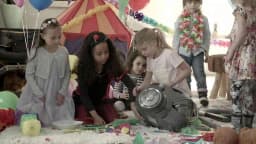
Orange Switzerland's 'Bone, Groom, Carpet' campaign, created by Publicis in January 2013, used three symbolic films to reframe telecom frustrations without a

How Orange Switzerland Turned Everyday Objects Into a Telecom Argument
Orange Switzerland's 'Bone, Groom, Carpet' is a three-asset film campaign created by Publicis Communications Schweiz AG, BSW, Zurich, and published in Switzerland in January 2013, using symbolic object-led storytelling to communicate the brand's telecommunications proposition without conventional product demonstration.
Each of the three films takes a single everyday object — a bone, a grooming act, and a carpet — and positions it as a metaphor for a recognisable telecommunications problem. Rather than showing handsets, data speeds, or pricing, the campaign invites Swiss audiences to read meaning into imagery, treating miscommunication, tangled connections, and technological disorder as shared human experiences rather than technical failures. This distinction places 'Bone, Groom, Carpet' firmly in the tradition of European brand advertising that prioritises emotional resonance over specification-led persuasion.
The campaign launched in Switzerland at a commercially significant moment. Orange held 19.4% mobile market share at year-end 2013, according to Comcom Admin Ch, the Swiss Federal Communications Commission — a position that placed it firmly behind market leader Swisscom and in direct competition with Sunrise, which commanded 22.6% share in the same period. For a brand occupying that middle-ground position, the strategic logic of differentiation through tone and creative ambition rather than tariff comparison is legible. Orange Switzerland was also operating under new ownership, having been acquired by Apax Partners in 2012, according to prophet.com, a transition that would eventually lead to its repositioning as Salt in 2015. The 2013 campaign therefore sits at a pivotal point in the brand's commercial and creative history, with Publicis serving as the agency partner guiding its voice in the Swiss market.
Orange Switzerland occupied a structurally challenging position in the Swiss mobile market entering 2013. The brand held 2.146 million active customers and 19.4% market share at year-end 2013, according to comcom.admin.ch, while Swisscom led the market with 6.407 million customers and 58.0% share. Sunrise sat between the two with 2.491 million customers and 22.6% share, also per comcom.admin.ch. Total active mobile customers across the three principal operators reached approximately 11.04 million in that period, according to comcom.admin.ch, making Switzerland a mature, saturated market where customer acquisition depended on brand distinction as much as network performance.
In that environment, competing on price or feature parity against Swisscom's dominant infrastructure narrative carried diminishing returns for a challenger brand. The decision by Publicis Communications Schweiz to build a film campaign around symbolic rather than comparative messaging reflects a strategic read of that constraint. By translating telecommunications pain points into visual metaphors — frustration rendered as a bone, disorder as tangled grooming, disruption as a displaced carpet — the agency sidestepped specification wars and positioned Orange as a brand capable of understanding its customers' experiences rather than simply correcting their bills.
This approach also aligned with a broader creative trajectory. Orange Switzerland had previously worked with Saatchi and Saatchi, whose 2010 three-film campaign used character- and situation-led storytelling, according to clapboard.com. The transition to Publicis and to object-led symbolic treatment represented a deliberate evolution in creative language — moving from relatable characters to abstracted ideas, asking audiences in Switzerland to do more interpretive work and rewarding that effort with a sense of brand intelligence.
Creative director Peter Rettinghausen and art director Grischa Rubinick led the campaign at Publicis Communications Schweiz AG, BSW, Zurich. Their approach placed the visual burden of argument on three inanimate objects rather than on actors, dialogue, or product demonstrations, a choice that demanded precise direction to prevent the films from collapsing into ambiguity without meaning.
Director Martin Aamund took on that challenge through production company Tuna Productions. Aamund's task was to build legible emotional logic into each film purely through the relationship between object, framing, and context. The symbolic vocabulary — bone, grooming, carpet — required each film to operate as a self-contained argument while also cohering as part of a trilogy. That structural discipline is one of the more demanding constraints a director can work within on a campaign of this kind, where three distinct films must feel like one creative system rather than three separate executions.
The campaign uses symbolic visual storytelling rather than straightforward product demonstration. This is a technique with a strong lineage in European telecommunications advertising, where brands have long used metaphor to humanise technical services. What distinguishes the Rubinick and Rettinghausen approach here is the specificity of the objects chosen: each has an intrinsic behavioural quality — a bone is contested, grooming involves entanglement, a carpet can conceal disorder — that maps with some precision onto recognised telecommunications frustrations rather than onto generic ideas of connection or freedom. The result is a campaign whose creative intelligence is visible in its construction, even where its ultimate communicative effectiveness depends on audience willingness to engage with the metaphorical register. Derya Derdiyok is credited on the production, contributing to the campaign's broader creative team at Publicis.
No verified performance data for 'Bone, Groom, Carpet' is publicly available. No published sales lift, brand tracking uplift, or market-share movement attributable to the campaign has been identified, and no entries or wins across Cannes Lions, the Effies, The One Show, D&AD, the Clios, the Webby Awards, or WARC Awards have been found, according to clapboard.com.
Structural analysis offers a partial substitute. The campaign's decision to run three films — rather than a single hero execution — signals a media commitment consistent with a brand seeking sustained presence rather than a single moment of attention. In a market as concentrated as Switzerland, where comcom.admin.ch data shows Orange holding the third position among three principal operators, campaign frequency and consistency of brand voice carry disproportionate weight. Three films using a unified symbolic system multiply exposure opportunities while reinforcing a single creative argument, which is an architecturally sound response to the competitive conditions Orange faced in January 2013.
The limitation of the approach is also structural. Symbolic advertising requires audience investment and interpretive willingness that cannot be guaranteed, particularly in a consumer electronics and telecommunications context where pragmatic decision-making — price, coverage, contract terms — remains dominant. Without evidence that the metaphorical framework was decoded as intended by Swiss audiences, the campaign's persuasive reach remains difficult to assess from the archive record alone.
Clapboard Score: 56 out of 100. The score reflects creative ambition that is evident in construction but unverified in outcome, with the absence of awards recognition and performance data limiting the archive's ability to assess real-world impact beyond the work itself.
'Bone, Groom, Carpet' is a three-film campaign created by Publicis Communications Schweiz AG for Orange Switzerland, published in January 2013. Each film uses a symbolic everyday object to represent a telecommunications frustration, replacing product demonstration with metaphorical visual storytelling aimed at Swiss audiences. All three assets are archived at clapboard.com.
Publicis Communications Schweiz AG, BSW, Zurich, created the campaign. Creative director Peter Rettinghausen and art director Grischa Rubinick led the work, with director Martin Aamund executing the films through Tuna Productions. Derya Derdiyok also contributed to the creative team. The campaign launched in Switzerland in January 2013.
Orange Switzerland held 19.4% mobile market share and 2.146 million active customers at year-end 2013, according to comcom.admin.ch. Swisscom led the market with 58.0% share, and Sunrise held 22.6%, placing Orange third among the three principal operators in a mature Swiss mobile market.
No awards have been identified for 'Bone, Groom, Carpet' across Cannes Lions, the Effies, The One Show, D&AD, the Clios, the Webby Awards, or WARC Awards, according to clapboard.com. The campaign received a Clapboard Score of 56 out of 100, reflecting creative ambition without verified industry recognition or published performance outcomes.
Orange occupied third place in the Swiss mobile market, behind dominant leader Swisscom and rival Sunrise, making price or specification comparison a structurally weak strategy. Publicis chose symbolic object-led films to differentiate Orange through creative tone and emotional intelligence rather than tariff claims, a logical response to the brand's challenger position in Switzerland.
Orange Switzerland transitioned from Saatchi and Saatchi to Publicis around 2012 to 2013, shifting from character-based storytelling to object-led symbolic film, according to clapboard.com. The brand had been acquired by Apax Partners in 2012, per prophet.com, and was later repositioned as Salt in 2015, making 'Bone, Groom, Carpet' one of its final Orange-branded campaigns.
.webp)
Creative Collaboration Platform: The Backbone of Modern Creative WorkWhat is a creative collaboration platform?Clapboard defines a creative collaboration platform as the operational core for today’s distributed creative teams. This is not a collection of digital collaboration tools stitched together; Clapboard’s system


Understanding the Creative Production MarketplaceWhat is a Creative Production Marketplace?Clapboard defines a creative production marketplace as a structured ecosystem where brands, agencies, and production talent converge to execute video, advertising, and branded content at scale. Unlike the legacy agency or freelanREAD FULL ARTICLE

The Urgent Need for a Creative Production Operating SystemWhy Traditional Creative Production Models Break DownClapboard sees the creative production landscape shifting under pressure. Content velocity is no longer a buzzword—it’s a mandate. Modern advertising demands relentless output across dozens of channels, each wREAD FULL ARTICLE